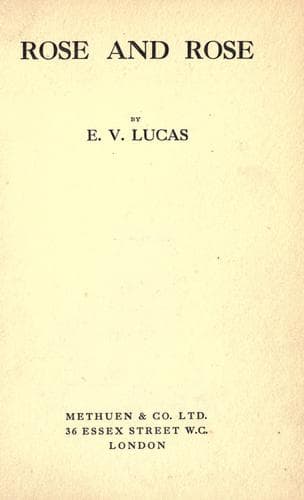
England -- Social life and customs -- Fiction; Guardian and ward -- Fiction; Physicians -- Fiction; Single men -- Fiction
“Very well then,” I said. “You are one of the most remarkable of
far-sighted women. Deborah the prophetess was a blind mute compared with
you; Mother Shipton was an Aunt Sally. I give you all the praise and
glory. But meanwhile, what is to be done? I’m sure that Rose is making
a mistake.”
“Most people who marry do,” said this monstrous old woman.
“Then can’t it be stopped?” I asked.
“I don’t see how. Surely you’ve heard the remark—I’m not very original
this afternoon, I’m afraid—’Marriage is a lottery’?”
“Well?”
“Well, then there’s nothing for you to do. It may be all right. You say
that he’s respectable, a barrister, not poor, not deformed. How then can
you stop it? You’ve got nothing to go on, no valid excuse. If he were a
dwarf you might do something; or a tenor with long hair. But I don’t see
how you could stop her even then, because in marriage the promising
matches often go wrong and the apparently ill-assorted have a very good
time. Besides, she’s only a few months from being her own mistress. You
can grumble, but you can’t prevent.”
And that’s all the comfort that I got from Mrs. O’Gorman.
* * * * *
But there was one drop of sweetness in this bitter draught. Rose’s
engagement meant that she returned to me; she gave up her work almost at
once.
Nothing, however, was as it had been. (Nothing, says the cynic, ever
is.) Our old frank intimacy was over. We had our talks and our walks
and our fun still; but there was a skeleton at the feast, and he was a
rising barrister. Rose didn’t mention him much, nor did I. But she
wrote long letters, and received long letters, and I had no doubt that
Eustace Holt received those that she wrote and signed those that she
received. And then one evening she suggested that he should be asked
down.
“You’ll have to see him sooner or later,” she added.
“Then it’s still on?” I inquired.
“Of course,” said Rose. “I should have told you if it hadn’t been. When
you meet him you’ll like him. Or you would if you hadn’t made up your
mind not to, and haven’t got the pluck to eat humble pie.”
I never liked him, but it would have been difficult to say why. He was
tall, comely, well-mannered, deferential, thoughtful about details,
protective of Rose (perhaps that was his real offence), uniformly quiet
and easy. What he lacked most conspicuously was any exaggerated
characteristic. He conversed fluently and with some knowledge upon all
the cultured topics—he knew about pictures and music, as a frequenter of
the National Gallery and the Crystal Palace concerts; he belonged to the
London Library; he played golf at the Old Deer Park; he had good nails.
He dressed well. His suit case was of the solidest leather. In fact, he
was all that he should have been and—alas!—nothing that he should not.
He reminded me of a well-bound book in a gentleman’s library—the kind of
book that no gentleman’s library should be without, but which makes no
appeal to be read.
Public-domain text, read in full here on John Shaqi.
Reviews
Reviews
No reviews yet
Be the first to share your thoughts on this work.
Join the Discussion
Join the discussion
Sign in to leave a comment or review.
Sign InorCreate an account