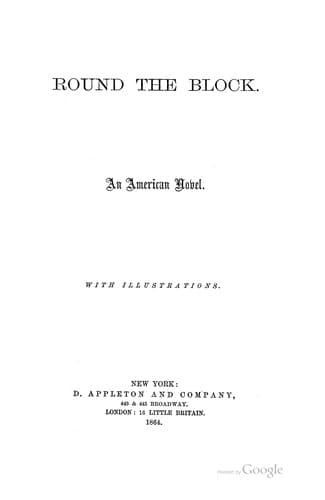
Round the Block: An American NovelBouton, John Bell
General
Round the Block: An American Novel
Bouton, John Bell
City and town life -- Fiction; Male friendship -- Fiction; New York (N.Y.) -- Social life and customs -- Fiction
About the middle of the block was a colony of doctors, who had
increased, in five years, from two to ten. Their march was eastward, and
it could be calculated to a nicety how long it would be before the small
black, gilt-lettered signs of their profession would press hard upon the
great house at the corner. Why they thus congregated together, unless
with the friendly purpose of relieving each other's patients in each
other's absence, and so saving humanity from sudden suffering and death,
was a mystery to everybody but themselves.
The north side lacked variety. One part of it, comprising twenty lots,
had been built up on speculation by an enterprising landowner. The
houses were precisely alike, from coal cellar to chimney top, with front
railings of exactly the same pattern, crowned with iron pineapples from
the same mould, encompassing little plots of ground laid out in walks
similar to the fraction of a hair; the sole ornaments of which were four
little spruce trees, planted at equal distances apart.
This row of houses was very distracting even to the occupants, with whom
it was a feat of arithmetic to identify their homes in the daytime, and
much more so at night, when the landmarks were shadowy and
indistinguishable. Occasionally, well-meaning tenants found themselves
pulling at wrong doorbells; and there was one man who got tipsy every
Saturday night, and rang himself quite through the row before he tumbled
in on his own hall carpet. It was in counting the spruce trees, he said,
which had a perplexing way of doubling, that he invariably lost
the track.
In nearly every house on this block there was a piano. The piano was the
great equalizer of the block. And, though in the loftier houses the
pianos might have been larger and costlier, and unquestionably noisier,
it did not follow that they were better played or pleasanter to hear
than the humbler instruments which served to swell the tumultuous chorus
in hours of morning practice. With regard to these pianos, it may here
be observed, that a gentleman with a passion for statistics, who chanced
to be well acquainted through the block, made the remarkable discovery
that the players were usually unmarried ladies; and that, when they
acquired husbands (as they occasionally did on that block), they put
aside the piano as something quite incapable of contributing to their
new-found happiness.
CHAPTER II.
THREE BACHELOKS.
Public-domain text, read in full here on John Shaqi.
Reviews
Reviews
No reviews yet
Be the first to share your thoughts on this work.
Join the Discussion
Join the discussion
Sign in to leave a comment or review.
Sign InorCreate an account