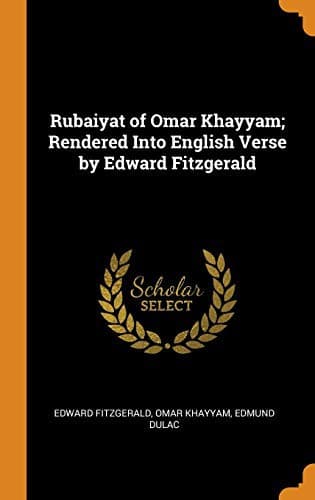
Rubáiyát of Omar Khayyam, Rendered into English VerseOmar Khayyam
GeneralSufism
Rubáiyát of Omar Khayyam, Rendered into English Verse
Omar Khayyam
Persian poetry -- Translations into English
"Euphranor" furnishes a good many characterizations which would be
useful for any writer treating upon Cambridge society in the third
decade of this century. Kenelm Digby, the author of the "Broadstone of
Honour," had left Cambridge before the time when Euphranor held his
"dialogue," but he is picturesquely recollected as "a grand swarthy
fellow who might have stepped out of the canvas of some knightly
portrait in his father's hall--perhaps the living image of one sleeping
under some cross-legged _effigies_ in the church." In "Euphranor," it is
easy to discover the earliest phase of the unconquerable attachment
which Fitzgerald entertained for his college and his life-long friends,
and which induced him in later days to make frequent visits to
Cambridge, renewing and refreshing the old ties of custom and
friendship. In fact, his disposition was affectionate to a fault, and he
betrayed his consciousness of weakness in that respect by referring
playfully at times to "a certain natural lubricity" which he attributed
to the Irish character, and professed to discover especially in himself.
This amiability of temper endeared him to many friends of totally
dissimilar tastes and qualities; and, by enlarging his sympathies,
enabled him to enjoy the fructifying influence of studies pursued in
communion with scholars more profound than himself, but less gifted with
the power of expression. One of the younger Cambridge men with whom he
became intimate during his periodical pilgrimages to the university, was
Edward B. Cowell, a man of the highest attainment in Oriental learning,
who resembled Fitzgerald himself in the possession of a warm and genial
heart and the most unobtrusive modesty. From Cowell he could easily
learn that the hypothetical affinity between the names of Erin and Iran
belonged to an obsolete stage of etymology; but the attraction of a
far-fetched theory was replaced by the charm of reading Persian poetry
in companionship with his young friend, who was equally competent to
enjoy and to analyze the beauties of a literature that formed a portion
of his regular studies. They read together the poetical remains of
Khayyám--a choice of reading which sufficiently indicates the depth and
range of Mr. Cowell's knowledge. Omar Khayyám, although not quite
forgotten, enjoyed in the history of Persian literature a celebrity
like that of Occleve and Gower in our own. In the many _Tazkirát_
(memoirs or memorials) of Poets, he was mentioned and quoted with
esteem; but his poems, laboring as they did under the original sin of
heresy and atheism, were seldom looked at, and, from lack of demand on
the part of readers, had become rarer than those of most other writers
since the days of Firdausi. European scholars knew little of his works
beyond his Arabic treatise on Algebra, and Mr. Cowell may be said to
have disentombed his poems from oblivion. Now, thanks to the fine taste
of that scholar, and to the transmuting genius of Fitzgerald, no Persian
Public-domain text, read in full here on John Shaqi.
Reviews
Reviews
No reviews yet
Be the first to share your thoughts on this work.
Join the Discussion
Join the discussion
Sign in to leave a comment or review.
Sign InorCreate an account