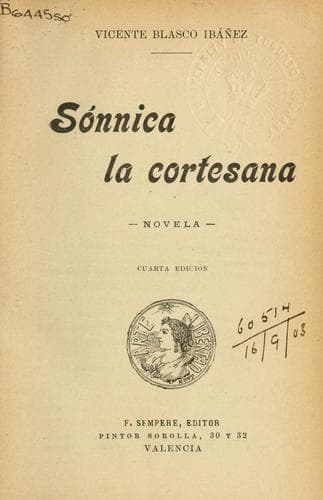
Sagunto (Spain) -- History -- Siege, 219-218 B.C. -- Fiction
She did not love him as she had loved the poet, but the earnest humility
of Bomaro, his respectful and docile love, so different from the ardor
she inspired in others, moved Myrrhina to a sentiment of gratitude.
One night, the Iberian, who seemed preoccupied, ventured after much
vacillation to express his inner thought.
He could not live without her; he would never return alone to Zacynthus;
he was resolved to abandon his fortune rather than never to see her
more. He would sooner be a stevedore on the wharf at Phalerum; and
finally, like one who makes a dash to more quickly overcome an obstacle,
he abruptly proposed to make her his wife, turning his fortune over to
her, and to take her to smiling Zacynthus with its flowery fields and
its rose-colored mountains, so like those of Attica.
Myrrhina smiled while listening to him and her heart was touched by the
affectionate self-abnegation of the Iberian who, to unite with her
forever, was willing to overlook a shameful past in the _dicterion_ and
in the Cerameicus. She rejected his proposals with an ironical smile;
but Bomaro was persistent. Was she not tired of her mode of life, of
seeing herself flattered as a thing of great price, but often scorned by
coarse creatures who thought they made themselves her masters by merely
offering their gold? Would she not like to be a sovereign on the coasts
of Iberia, surrounded by people who would admire her Athenian
attainments?
Bomaro conquered her by his loving determination, and one day Athens
beheld with surprise that the house on the Street of Tripods was sold,
and that Myrrhina's slaves were carrying to the port the riches gathered
during three years of mad fortune, loading them in the ships of the
Iberian who had unfurled from the masts his purple sails for a triumphal
voyage.
Myrrhina, in her desire to propitiate him who gave himself up to her so
completely, wished to leave her whole past behind. She proposed to be a
new woman, to put away her sinister cognomen, and begging Bomaro to
repeat the most beautiful names of the Iberian women, she chose that of
Sónnica as the most pleasing to her ears.
Arrived at Zacynthus, the navigator and the Greek woman were married in
the temple of Diana before all the Senate, of which the young man was
himself a member.
The city felt the effects of the charm which seemed to emanate from the
person of Sónnica. She was like a breath from distant Athens, which
fascinated the Greek merchants in Saguntum, grown slack by their long
stay among uncultured foreigners.
Public-domain text, read in full here on John Shaqi.
Reviews
Reviews
No reviews yet
Be the first to share your thoughts on this work.
Join the Discussion
Join the discussion
Sign in to leave a comment or review.
Sign InorCreate an account