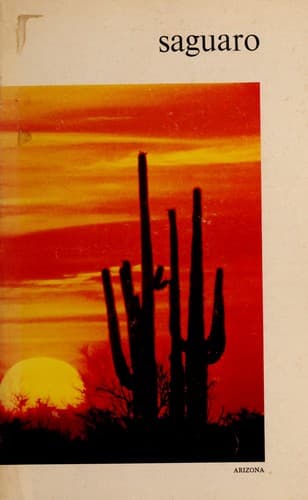
Desert ecology -- Arizona -- Saguaro National Park; Natural history -- Arizona -- Saguaro National Park
Although billions of saguaro seeds are produced yearly in the extensive
stands of the monument, only a very few find favorable locations for
germination and growth. Trees, rocks, dead limbs, pebbles—anything that
reduces evaporation in the immediate vicinity of the seed—improve the
chance of germination. These kinds of shelter not only provide the
necessary moisture conditions, but also hide the seed from armies of
ants, rodents, and other animals searching for food.
[Illustration: Saguaro blossoms.]
[Illustration: Saguaro fruit.]
Early growth is extremely slow. A 2-year-old saguaro may be only
one-quarter of an inch in diameter, and a 9-year-old plant may be 6
inches high. These years are the most hazardous. Insect larvae devour
the tiny cactuses. Woodrats and other rodents chew the succulent tissue
for its water, and ground squirrels uproot the young plants with their
digging. In later life, the saguaro must contend with uprooting wind and
human vandalism, as well as the earlier foes—drought, frost, erosion,
and animals.
[Illustration: Gila woodpecker at its nesting hole.]
In a century of maturity, a saguaro may produce 50 million seeds;
replacement of the parent plant would require only that one of these
germinate and grow. But in the cactus forest of the Rincon Mountain
Section, the rate of survival has been even lower, so that over the last
few decades the stand has been dwindling. What is wrong?
Many answers to this question have been advanced, but like all
interrelationships in nature, the saguaro’s role in the desert web of
life is very complex, and involves past events as well as present ones;
a partial answer to the problem may be all we can hope for. The
following reasons for the decline of the saguaros have been suggested by
researchers.
[Illustration: Saguaro, 1 foot high, in a rocky habitat.]
[Illustration: A typical 4-foot saguaro.]
There is some evidence to suggest that the Southwest has been getting
drier since at least the late 19th century, and while the saguaro is
adapted to extreme aridity, some of the “nurse” plants that shelter it
during infancy are not. If such shrubs as paloverdes and mesquites
dwindle, it is argued, so must the saguaro, which in its early years
depends on them for shade.
Public-domain text, read in full here on John Shaqi.
Reviews
Reviews
No reviews yet
Be the first to share your thoughts on this work.
Join the Discussion
Join the discussion
Sign in to leave a comment or review.
Sign InorCreate an account