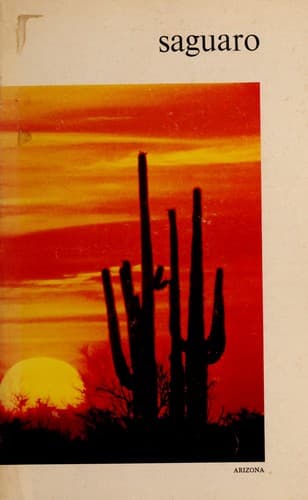
Desert ecology -- Arizona -- Saguaro National Park; Natural history -- Arizona -- Saguaro National Park
Other culprits in the saguaro problem are man himself and his livestock.
Around 1880, soon after the first railroad reached Tucson, a cattle boom
began in southern Arizona. The valleys were soon overstocked, and cattle
scoured the mountainsides in search of food. By 1893, when drought and
starvation decimated the herds, the land had been severely overgrazed.
Though the monument was established in 1933, grazing in the Rincon
Mountain Section’s main cactus forest continued until 1958. (Elsewhere
in the monument, it still goes on.) Compounding the problem, woodcutters
removed acres of mesquite and other trees. In the center of the present
Cactus Forest Loop Drive, lime kilns devoured quantities of woody fuel.
Further upsetting the desert’s natural balance, ranchers and Government
agents poisoned coyotes and shot hawks and other predators—in the belief
that this would benefit the owners of livestock.
This unrestrained assault on the environment had unfortunate effects on
saguaros as well as on the human economy. Overgrazing may have resulted
in an increase in kangaroo rats (which benefit from bare ground on which
to hunt seeds) and certain other rodents adapted to an open sort of
ground cover. Man’s killing of predators, their natural enemies, further
encouraged proliferation of these rodents, which some people say are
especially destructive of saguaro seeds and young plants. Whatever the
effect these rodents have on the saguaros, the removal of ground cover
intensified erosion and reduced the chances for the seeds to germinate
and grow. And certainly the cutting of desert trees removed shade that
would have benefited young saguaros. In the Tucson Mountain Section,
which is near the northeastern edge of the Sonoran Desert, freezing
temperatures are perhaps the most important environmental factor in
saguaro mortality.
[Illustration: Looking toward the Santa Catalina Mountains from
Cactus Forest Drive in September 1942.]
Although the causes of decline of the cactus forest lying northwest of
Tanque Verde Ridge are still something of a puzzle, several facts are
clear: the saguaro is not becoming extinct; in rocky habitats many young
saguaros are surviving, promising continued stands for the future; in
non-rocky habitats, some young saguaros are surviving, ensuring that at
least thin stands will endure in these areas. Furthermore, since grazing
was stopped here, ground cover has improved—a plus factor for the
saguaro’s welfare. On the negative side, it is possible that, in
addition to suffering from climatic, biotic, and human pressures, the
once-dense mature stands of the monument are in the down-phase of a
natural fluctuation. It is possible, too, that these stands owed their
exceptional richness to an unusually favorable past environment which
may not occur again. We can hope, however, that sometime in the
not-distant future the total environmental balance will shift once again
in favor of the giant cactus.
Public-domain text, read in full here on John Shaqi.
Reviews
Reviews
No reviews yet
Be the first to share your thoughts on this work.
Join the Discussion
Join the discussion
Sign in to leave a comment or review.
Sign InorCreate an account