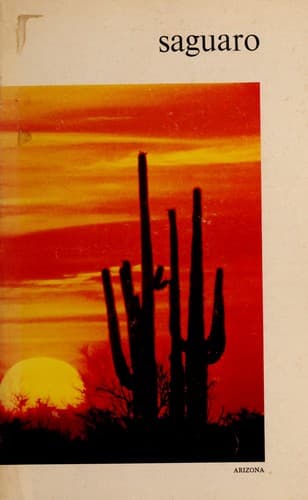
Desert ecology -- Arizona -- Saguaro National Park; Natural history -- Arizona -- Saguaro National Park
There is WILD CARROT, which is a summer plant in South Carolina and a
winter annual in California (where it is called “rattlesnake weed”). In
the desert, its seeds lie dormant in the soil through the long, hot
summer and the drying weather of autumn. Then, under the influence of
winter rains and the soil-warming effects of early spring sunshine, they
burst into rapid growth. One of a host of species, this early spring
ephemeral is enabled by these favorable conditions to flower and mature
its seed before the pall of summer heat and drought descends upon the
desert. With their task complete, the parents wither and die. Their
ripened seeds are scattered over the desert until winter rains enable
them to cover the desert with another multicolored but short-lived
carpet of foliage and bloom.
The one-season ephemerals do not limit themselves to the winter growing
period. From July to September, local thundershowers deluge parts of the
desert while other areas, not so fortunate, remain dry. Where rain has
fallen, another and entirely different group of plants, called the
summer ephemerals, find ideal conditions for growth and take their turn
at weaving a desert carpet. Their seeds have lain dormant over winter.
These summer “quickies” are plants that, farther south in Baja
California and Sonora, Mexico, flourish during the winter rainy season.
Saguaro National Monument is doubly fortunate in that it lies within a
section of desert having not only its own year-round vegetation, but
also summer wildflowers “borrowed,” for winter use, from its eastern and
western neighbors, and winter wildflowers for summer decorations from
its southern neighbors.
[Illustration: Phacelia, an ephemeral.]
The short-lived leafy plants of summer and winter are able to compress
their entire active life into 6 to 12 weeks when conditions are most
suitable. Thus, they can escape all the rigorous periods of the desert
climate by living for 8 or 9 months in the dormant seed stage. Some of
the spectacular and colorful flowers of the monument are among these
ephemerals that survive desert conditions by escaping them. It must be
remembered, however, that when drought conditions or abnormally cold
spring weather upset the norm—a not unusual occurrence—response of
ephemeral plants is greatly restricted. If suitable conditions do not
develop during the season for growth of a particular kind of ephemeral,
its seeds will simply wait a year or more until conditions are
favorable.
[Illustration: White tackstem.]
Public-domain text, read in full here on John Shaqi.
Reviews
Reviews
No reviews yet
Be the first to share your thoughts on this work.
Join the Discussion
Join the discussion
Sign in to leave a comment or review.
Sign InorCreate an account