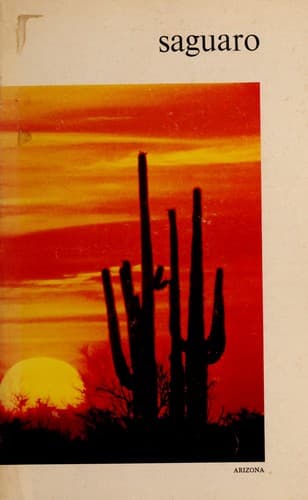
Desert ecology -- Arizona -- Saguaro National Park; Natural history -- Arizona -- Saguaro National Park
While these daily and seasonal cycles are following their well-known
courses, each species of plant and animal is undergoing its own
fluctuations, in a constant struggle that generally goes unnoticed. For
the balance of nature is not a static one, but more like the rocking of
a seesaw on its fulcrum. The population of a species goes up one year,
down another—depending on the weather, the food supply, predators,
competitors, and a thousand interactions that reverberate through the
community in which it lives. The numbers of some species, like the
Gambel’s quail, fluctuate wildly from year to year, while those of
others, such as the harvester ant, remain quite stable. But the
oscillations of the seesaw, big and little, average out from year to
year so that the species maintains itself in the community. The other
members are going through the same thing, in a system of checks and
balances that over the short run keeps the whole community nearly
constant.
But over decades, centuries, or longer, the fulcrum of the seesaw moves:
the larger environment changes, and the community and its constituent
plants and animals must change with it or perish. Such changes may be
climatic, as we saw with the formation of the Southwestern deserts; or
it may be geologic, as with the rising and partial disintegration of the
Rincon Mountains. The efforts of plant and animal species to meet such
changes constitute in large part the story of evolution, for new
environments spawn newly evolved forms of life. Evidence of such
evolution we have seen in the plants of the Sonoran Desert, notably the
giant saguaro cactus, whose prickly ancestor lived in the West Indies
only 20,000 years ago.
Thus nature is ever-changing; and the inexorable rule for all living
things is, “adapt or perish.” Before technological man enters the scene,
the slow evolutionary process can keep pace with the changing
environments, though here and there a species is dropped by the wayside.
Generally, communities of living things reach new equilibria without
serious disruption.
But what happens when man, with his machines and his passion for
progress, institutes changes of a speed and kind and on a scale
drastically different from those brought about by earthquakes, storms,
shifting climates, and other natural phenomena? What happens to the
living things that have adapted to the harsh desert environment when
that environment is drastically altered?
[Illustration: Saguaro cactus being uprooted.]
the impact of man
Man has been a part of the scene in this region for several thousand
years, but until recent times his influence on it was minimal. Only with
the rapid technological development of the last century has man been
able to make a major impact on this landscape. Thus the story of man,
here as elsewhere, is a story of gradually accelerating power to change
environments, a power that now threatens to destroy environments, and
with them, man himself.
Public-domain text, read in full here on John Shaqi.
Reviews
Reviews
No reviews yet
Be the first to share your thoughts on this work.
Join the Discussion
Join the discussion
Sign in to leave a comment or review.
Sign InorCreate an account