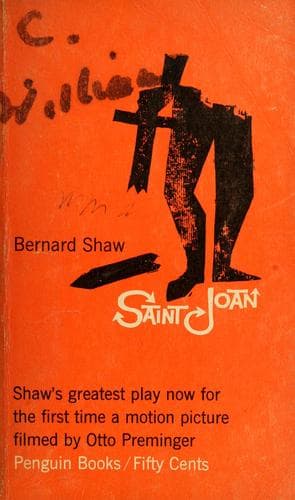
Saint Joan : $b A chronicle play in six scenes and an epilogue — John Shaqi
Saint Joan : $b A chronicle play in six scenes and an epilogueShaw, Bernard
HistoryHistory
Saint Joan : $b A chronicle play in six scenes and an epilogue
Shaw, Bernard
Christian women saints -- Drama; France -- History -- Charles VII, 1422-1461 -- Drama; Joan, of Arc, Saint, 1412-1431 -- Drama
English king whose crown she had kicked into the Loire, were equally
glad to be rid of her.
Was Joan Innocent or Guilty?
As this result could have been produced by a crapulous inferiority as
well as by a sublime superiority, the question which of the two was
operative in Joan’s case has to be faced. It was decided against her by
her contemporaries after a very careful and conscientious trial; and the
reversal of the verdict twentyfive years later, in form a
rehabilitation of Joan, was really only a confirmation of the validity
of the coronation of Charles VII. It is the more impressive reversal by
a unanimous Posterity, culminating in her canonization, that has quashed
the original proceedings, and put her judges on their trial, which, so
far, has been much more unfair than their trial of her. Nevertheless the
rehabilitation of 1456, corrupt job as it was, really did produce
evidence enough to satisfy all reasonable critics that Joan was not a
common termagant, not a harlot, not a witch, not a blasphemer, no more
an idolater than the Pope himself, and not ill conducted in any sense
apart from her soldiering, her wearing of men’s clothes, and her
audacity, but on the contrary good-humored, an intact virgin, very
pious, very temperate (we should call her meal of bread soaked in the
common wine which is the drinking water of France ascetic), very kindly,
and, though a brave and hardy soldier, unable to endure loose language
or licentious conduct. She went to the stake without a stain on her
character except the overweening presumption, the superbity as they
called it, that led her thither. It would therefore be waste of time now
to prove that the Joan of the first part of the Elizabethan chronicle
play of Henry VI (supposed to have been tinkered by Shakespear) grossly
libels her in its concluding scenes in deference to Jingo patriotism.
The mud that was thrown at her has dropped off by this time so
completely that there is no need for any modern writer to wash up after
it. What is far more difficult to get rid of is the mud that is being
thrown at her judges, and the whitewash which disfigures her beyond
recognition. When Jingo scurrility had done its worst to her, sectarian
scurrility (in this case Protestant scurrility) used her stake to beat
the Roman Catholic Church and the Inquisition. The easiest way to make
these institutions the villains of a melodrama was to make The Maid its
heroine. That melodrama may be dismissed as rubbish. Joan got a far
fairer trial from the Church and the Inquisition than any prisoner of
her type and in her situation gets nowadays in any official secular
court; and the decision was strictly according to law. And she was not a
melodramatic heroine: that is, a physically beautiful lovelorn parasite
on an equally beautiful hero, but a genius and a saint, about as
completely the opposite of a melodramatic heroine as it is possible for
a human being to be.
Public-domain text, read in full here on John Shaqi.
Reviews
Reviews
No reviews yet
Be the first to share your thoughts on this work.
Join the Discussion
Join the discussion
Sign in to leave a comment or review.
Sign InorCreate an account