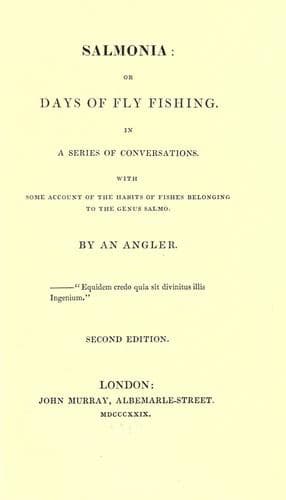
Salmonia; Or, Days of Fly Fishing: In a series of conversations. With some account of the habits of fishes belonging to the genus SalmoDavy, Humphry, Sir
Philosophy
Salmonia; Or, Days of Fly Fishing: In a series of conversations. With some account of the habits of fishes belonging to the genus Salmo
Davy, Humphry, Sir
Fishing
ORN.—Now the hucho is dressed, and on the same table with other species
of the salmo, I perceive his peculiarities more distinctly; and, in
addition to those you have mentioned, he appears to me to have a
stronger upper jaw, and a larger projection of bone below the orbit of
the eye.
HAL.—He has; and you will find a similar character in the pike and
perch, and, I believe, in most fishes of prey; and the use of it seems
to be, to strengthen the fulcrum of the lever on which the lower jaw
moves, so as to afford the means of greater strength to the whole
muscular apparatus, by means of which the fish seizes his prey.
POIET.—These fishes, then, are analogous to the predatory animals of the
feline genus, which have this part of the head exceedingly strong; and
it is here that the craniologists or phrenologists fix the organ of
courage: does not this extensive chain of analogies offer an argument in
favour of this long agitated and generally unpopular doctrine?
PHYS.—In my opinion, it offers, like most of the facts which have been
brought forward to prove the truths of the view of Gall and Spurzheim,
an argument rather unfavourable, when thoroughly and minutely examined.
POIET.—How?
PHYS.—In these rapacious and predatory animals, the organization of the
head must be connected with the functions of the jaws, as the
construction of the shoulder-blade must be related to the use of the
fore leg, which, being intended to strike and seize by talons, must have
a powerful support and a strong bony apparatus in the shoulder, which
might as well be called the organ of courage as the projection below the
frontal bone: but these animals have no more what is called courage in
man, than they have what is called reason: they face danger when they
are hungry, but almost always fly when their appetite is satisfied: a
hen, in defending her chickens against a powerful dog, or the game cock,
in fighting for the female, or the timid stag, at the time of the sexual
intercourse, shows quite as much of this quality as the most ferocious
royal tiger. Courage is the result of strong passions or strong motives;
and in man it usually results from the love of glory or the fear of
shame; and it appears to me a perfectly absurd idea, that of connecting
it with an organ, which is merely intended to assist the predatory
habits and the mastication of a carnivorous animal.
Public-domain text, read in full here on John Shaqi.
Reviews
Reviews
No reviews yet
Be the first to share your thoughts on this work.
Elsewhere in the archive
Join the Discussion
Join the discussion
Sign in to leave a comment or review.
Sign InorCreate an account