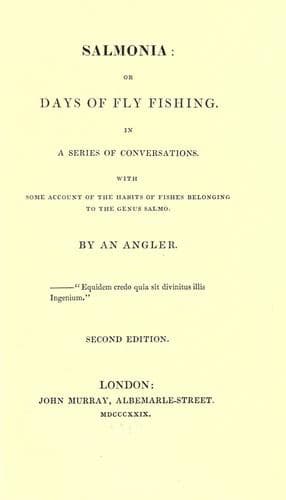
Salmonia; Or, Days of Fly Fishing: In a series of conversations. With some account of the habits of fishes belonging to the genus SalmoDavy, Humphry, Sir
Philosophy
Salmonia; Or, Days of Fly Fishing: In a series of conversations. With some account of the habits of fishes belonging to the genus Salmo
Davy, Humphry, Sir
Fishing
HAL.—I agree with Physicus in this view of the subject. I once heard a
physiologist of some reputation deducing an argument in favour of
craniology from the form of the skull of the beaver, which he called a
constructive animal, and contended, that there was something of the same
character in the skulls of distinguished architects: now, the skull of
the beaver is so formed, that he is able to use his jaws for cutting
down the trees with which he makes his dam; and if this analogy were
correct, the architect ought unquestionably to employ his teeth for the
same purpose; and though I have known distinguished men, who have been
in the habit of using knives for cutting furniture with a sort of
nervous restlessness of hand, I do not recollect to have heard of the
teeth being employed in the same way; and I think it would be quite as
correct, to find the architectural or constructive organ in the opposite
part of the body, the tail, as the beaver makes a more ingenious use of
this part than even of his mouth. Pray, have you ever observed, Poietes,
any particular protuberance in the nether parts of any of our
distinguished architects?
POIET.—I am not a craniologist; but I would have the doctrine overturned
by facts, and not by ridicule; and I have certainly seen some remarkable
instances, which were favourable to the system.
HAL.—My experience is entirely on the opposite side; and I once saw a
distinguished craniologist in error on a point, which he considered as
the most decided. He was shown two children, one of whom was possessed
of great mathematical acquirements, the other of extraordinary musical
taste. With the utmost confidence he pronounced judgment, and was
mistaken. It appeared to me, that, whilst he was examining the two
heads, he hummed an air, which, being out of tune, was not responded to
by the musical child; but somehow struck the fancy of the mathematical
one.
ORN.—This hucho is a very good fish, and, indeed, I can praise all the
varieties of the salmon on the table that I have yet tasted.
PHYS.—Amongst them, I prefer the char, which, I think, is even better
than the best fresh salmon I ever tasted.
POIET.—This char is surprisingly red and full of curd; I wonder at its
fat: It comes from the Grundtl See, which is a high Alpine lake, covered
with ice more than half the year: what food can the fish find in so pure
and cold a water?
Public-domain text, read in full here on John Shaqi.
Reviews
Reviews
No reviews yet
Be the first to share your thoughts on this work.
Elsewhere in the archive
Join the Discussion
Join the discussion
Sign in to leave a comment or review.
Sign InorCreate an account