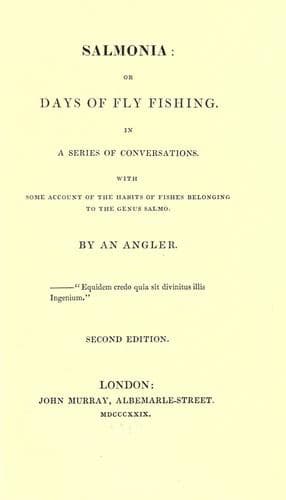
Salmonia; Or, Days of Fly Fishing: In a series of conversations. With some account of the habits of fishes belonging to the genus SalmoDavy, Humphry, Sir
Philosophy
Salmonia; Or, Days of Fly Fishing: In a series of conversations. With some account of the habits of fishes belonging to the genus Salmo
Davy, Humphry, Sir
Fishing
HAL.—Minnows and small chubs are found in this lake; and the flies which
haunt it in summer have been aquatic larvæ in the autumn, winter, and
spring; and there are usually great quantities of small shell fish,
which live in the deeper parts of this water; so that char may find food
even in winter; and cold, or the repose to which it leads, seems
favourable to the development or conservation of fat. Most of the polar
animals (the whale, moose, seal, and white bear, for instance) are
loaded with this substance; and the salmon of the Arctic Ocean are
remarkable for their quantity of curd: those that run up the rivers in
Russia from the White Sea are said to be fatter and better, than those
caught in the streams which run into the Baltic.
ORN.—I agree with Physicus in his praise of the char: we are indebted to
you for an excellent entertainment.
HAL.—At Lintz, on the Danube, I could have given you a fish dinner of a
different description, which you might have liked as a variety. The four
kinds of perch, the _spiegel carpfen_, and the _siluris glanis_; all
good fish, and which I am sorry we have not in England, where I doubt
not they might be easily naturalized, and they would form an admirable
addition to the table in inland counties. Since England has become
Protestant, the cultivation of fresh water fish has been much neglected.
The _burbot_, or lotte, which already exists in some of the streams
tributary to the Trent, and which is a most admirable fish, might be
diffused without much difficulty; and nothing could be more easy than to
naturalize the _spiegel carpfen_ and _siluris_; and I see no reason why
the _perca lucio perca_ and _zingel_ should not succeed in some of our
clear lakes and ponds, which abound in coarse fish. The new Zoölogical
Society, I hope, will attempt something of this kind; and it will be a
better object than introducing birds and beast of prey—though I have no
objection to any source of rational amusement or philosophical
curiosity.
POIET.—A fish dinner such as you have just described, combined with one
such as we have enjoyed to-day, might, I think, be made an interesting
experimental lecture on natural history. The analogies of the different
species and genera of fishes, so distinct in the form of their organs,
are likewise marked in the appearance and taste of their flesh. The
salmon and the char may be regarded as the generic types of the salmo.
By trout, which have sometimes red and sometimes white flesh, they are
connected with the grayling and hucho. By the grayling the trout is
connected with the laveret, and by the laveret the genus salmo is
connected with the carp genus. The char is immediately connected with
the grayling, and laveret by the umbula. By the sea trout the salmon is
connected with the trout; and by the hucho, with the pike and perch
families.
Public-domain text, read in full here on John Shaqi.
Reviews
Reviews
No reviews yet
Be the first to share your thoughts on this work.
Elsewhere in the archive
Join the Discussion
Join the discussion
Sign in to leave a comment or review.
Sign InorCreate an account