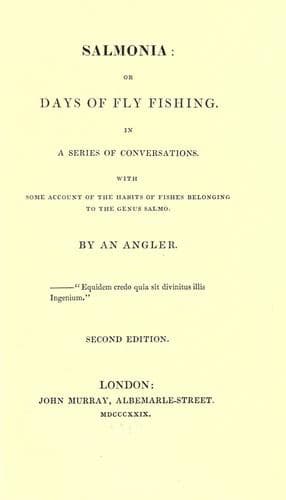
Salmonia; Or, Days of Fly Fishing: In a series of conversations. With some account of the habits of fishes belonging to the genus SalmoDavy, Humphry, Sir
Philosophy
Salmonia; Or, Days of Fly Fishing: In a series of conversations. With some account of the habits of fishes belonging to the genus Salmo
Davy, Humphry, Sir
Fishing
HAL.—We will arrange a dinner of this kind in England, and by means of
it follow the analogies of salt and fresh water fishes. But the time for
our parting is almost arrived.—Let us drink a glass each of this old
wine of the Danube to our next happy meeting, and go and take a last
look of the Fall of Traun, whilst our carriages are preparing.
[_They walk to the rock above the Fall of the Traun._]
HAL.—See, the cataract is now in great beauty; the river above is
coloured by the setting sun, and the glow of the rosy light on the upper
stream is beautifully and wonderfully contrasted with the tints of the
cataract below. Have you ever seen any thing so fine?
POIET.—The lights are beautiful; but I have certainly seen a finer
combination of features in the Fall of the Velino, at Terni, though that
water is not clear; but, even with this defect, it is certainly the most
perfect of European falls. This cascade of the Traun, though not so
elevated as that of Terni, and not so large as that of Schaffhausen,
yet, from its perfect clearness, and the harmony of the surrounding
objects, ranks high, as to picturesque effect, amongst the waterfalls of
Europe; and the wonderful transparency of its pale-green water gives it
a peculiar charm in my eyes, enhanced as it is now by the light of the
glowing western sky; and the tints of the quadrant iris on its spray are
not brighter than those of its stream and foam.
ORN.—We have now followed this water at least thirty miles, and wherever
we have seen it, it has always displayed the same characters of
clearness and rapidity—of green stream and white foam; and we have
traced it from the snowy mountains of Styria to the plains of Upper
Austria, where it serves to purify the darker Danube. How is it, that it
has preserved its transparency, though so many of its tributary streams
have been foul, either from the thunder storm, or from the sudden
melting of snows?
HAL.—The three small lakes and the two larger ones, which are in fact
its reservoirs, are the cause of this. The Gründtl See furnishes its
principal stream, and this lake is fed by two others—Töplitz See and
Lahngen See; and the tributary streams, which unite at Aussee, from
Alten Aussee and Oden See, though one is blue and the other yellow, yet
combine to give a tint, which is nearly the same as that from the stream
of the Gründtl See, and which the river retains throughout its course
Yet I have seen even this river very foul, but only in a part of its
course, below Ischel. I was once at that place, when the thunder storm
of a night having washed the dust of the roads into the river, it was
extremely turbid from Ischel to the Traun See. It rendered the upper
part of this large lake coloured; but, notwithstanding this, the river
came from the lower part of it perfectly clear, and I caught fish in it
there with a fly, which, at its entrance into the lake was quite
impossible.
Public-domain text, read in full here on John Shaqi.
Reviews
Reviews
No reviews yet
Be the first to share your thoughts on this work.
Elsewhere in the archive
Join the Discussion
Join the discussion
Sign in to leave a comment or review.
Sign InorCreate an account