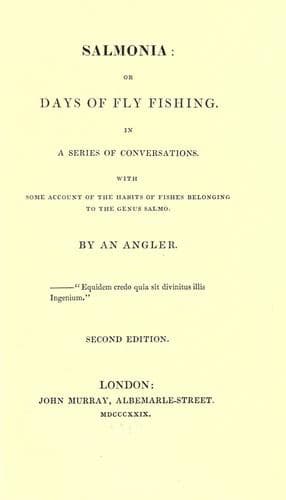
Salmonia; Or, Days of Fly Fishing: In a series of conversations. With some account of the habits of fishes belonging to the genus SalmoDavy, Humphry, Sir
Philosophy
Salmonia; Or, Days of Fly Fishing: In a series of conversations. With some account of the habits of fishes belonging to the genus Salmo
Davy, Humphry, Sir
Fishing
believes, generally spawns late in the winter, it may sometimes meet
with trout spawning at the same time. He has seen salmon and trout in
the Tweed in a similar state of maturity at the same period; and, in
1816, he remembers, that he took large female salmon, that had the
period of parturition protracted as late as March.
(_On the scolaphax, page 124._)
I shall say a few words on the congeners of this bird (the solitary
snipe,) and on the three varieties so much better known in Europe. The
woodcock feeds indiscriminately upon earthworms, small beetles, and
various kinds of larvæ, and its stomach sometimes contains seeds, which
I suspect have been taken up in boring amongst the excrements of cattle;
yet the stomach of this bird has something of the gizzard character,
though not so much as that of the land-rail, which I have found half
filled with seeds of grasses, and even containing corn, mixed with
may-bugs, earth-worms, grasshoppers, and caterpillars. The woodcock, I
believe, breeds habitually only in high northern latitudes, yet there
are woods in England, particularly one in Sussex, near the borders of
Hampshire, in which one or two couple of these birds, it is said, may
always be found in summer. I suspect these woodcocks are from the
offspring of birds which had paired for their passage, but being
detained by an accident happening to one of them, staid and raised a
young brood in England, and the young ones probably had their instincts
altered by the accidents of their being born in England, and being in a
place well supplied with food. It is not improbable, that they likewise
raised young ones, and that the habit of staying has become hereditary.
There can be no doubt, that woodcocks are very constant to their local
attachments; woodcocks, that have been preserved in a particular wood
for a winter, always return to it, if possible, the next season. Many
woodcocks breed in Norway and Sweden in the great, extensive, and moist
pine woods, filled with bogs and morasses, which cover these wild
countries, but probably a still greater number breed further north, in
Lapland, Finland, Russia, and Siberia. It is I believe a fable, that
they ever raise their young habitually in the high Alpine or mountainous
countries of the central or southern parts of Europe. These countries
indeed in summer are very little fitted for their feeding; they cannot
bore where it is either dry or frosty, and the glacier, as well as the
arid sand or rock, are equally unfitted for their haunts. They leave the
north with the first frost, and travel slowly south till they come to
their accustomed winter quarters; they do not usually make a quick
voyage, but fly from wood to wood, reposing and feeding on their
journey: they prefer for their haunts, woods near marshes or morasses;
they hide themselves under thick bushes in the day, and fly abroad to
feed in the dusk of the evening. A laurel, or a holly-bush, is a
Public-domain text, read in full here on John Shaqi.
Reviews
Reviews
No reviews yet
Be the first to share your thoughts on this work.
Elsewhere in the archive
Join the Discussion
Join the discussion
Sign in to leave a comment or review.
Sign InorCreate an account