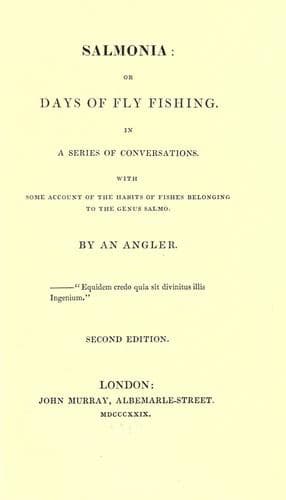
Salmonia; Or, Days of Fly Fishing: In a series of conversations. With some account of the habits of fishes belonging to the genus SalmoDavy, Humphry, Sir
Philosophy
Salmonia; Or, Days of Fly Fishing: In a series of conversations. With some account of the habits of fishes belonging to the genus Salmo
Davy, Humphry, Sir
Fishing
favourite place for their repose: the thick and varnished leaves of
these trees prevents the radiation of heat from the soil, and they are
less affected by the refrigerating influence of a clear sky, so that
they afford a warm seat for the woodcock. Woodcocks usually begin to fly
north on the first approach of spring, and their flights are generally
longer, and their rests fewer, at this season than in the autumn.
In the autumn they are driven from the north to the south by the want of
food, and they stop wherever they can find food. In the spring, there is
the influence of another powerful instinct added to this, the sexual
feeling. They migrate in pairs, and pass as speedily as possible to the
place where they are likely to find food, and to raise their young, and
of which the old birds have already had the experience of former years.
Scarcely any woodcocks winter in any part of Germany. In France there
are a few found, particularly in the southern provinces, and in Normandy
and Brittany. The woods of England, especially of the west and south,
contain always a certain quantity of woodcocks, but there are far more
in the moist soil and warmer climate of Ireland; but in the woods of
southern Italy and Greece, near marshes, they are far more abundant; and
they extend in quantities over the Greek Islands, Asia Minor, and
northern Africa.
The snipe is one of the most generally distributed birds belonging to
Europe. It feeds upon almost every kind of worm, or larvæ, and, as I
have said before, its stomach sometimes contains seeds and rice; it
prefers a country cold in the summer to breed in; but wherever there is
much fluid water, and great morasses, this bird is almost certain to be
found. Its nest is very inartificial, its eggs large, and the young ones
soon become of an enormous size, being, often before they can fly,
larger than their parents. Two young ones are usually the number in a
nest, but I have seen three. The old birds are exceedingly attached to
their offspring, and if any one approach near the nest they make a loud
and drumming noise above the head, as if to divert the attention of the
intruder. A few snipes always breed in the marshes of England and
Scotland, but a far greater number retire for this purpose to the
Hebrides and the Orkneys. In the heather surrounding a small lake in the
Island of Hoy, in the Orkneys, I found in the month of August, in 1817,
the nests of ten or twelve couple of snipes. I was grouse-shooting, and
my dog continually pointed them, and, as there were sometimes three
young ones and two old ones in the nest, the scent was very powerful.
From accident of the season these snipes were very late in being
hatched, for they usually fly before the middle of July; but this year,
even as late as the 15th of August, there were many young snipes that
had not yet their wing feathers. Snipes are usually fattest in frosty
weather, which, I believe, is owing to this, that in such weather they
Public-domain text, read in full here on John Shaqi.
Reviews
Reviews
No reviews yet
Be the first to share your thoughts on this work.
Elsewhere in the archive
Join the Discussion
Join the discussion
Sign in to leave a comment or review.
Sign InorCreate an account