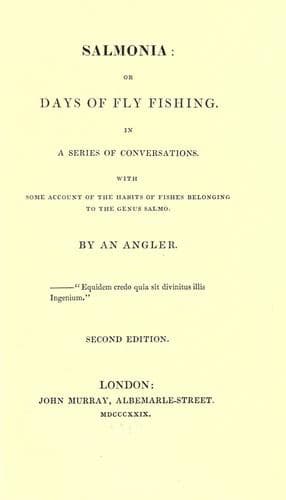
Salmonia; Or, Days of Fly Fishing: In a series of conversations. With some account of the habits of fishes belonging to the genus SalmoDavy, Humphry, Sir
Philosophy
Salmonia; Or, Days of Fly Fishing: In a series of conversations. With some account of the habits of fishes belonging to the genus Salmo
Davy, Humphry, Sir
Fishing
haunt only warm springs, where worms are abundant, and they do not
willingly quit these places, so that they have plenty of nourishment and
rest, both circumstances favourable to fat. In wet, open weather they
are often obliged to make long flights, and their food is more
distributed. The jack-snipe feeds upon smaller insects than the snipe:
small white larvæ, such as are found in black bogs, are its favourite
food, but I have generally found seeds in its stomach, once hemp-seeds,
and always gravel. I know not where the jack-snipe breeds, but I suspect
far north. I never saw their nest or young ones in Germany, France,
Hungary, Illyria, or the British Islands. The common snipe breeds in
great quantities in the extensive marshes of Hungary and Illyria; but I
do not think the jack-snipe breeds there, for, even in July and August,
with the first very dry weather, many snipes, with ducks and teal, come
into the marshes in the south of Illyria, but the jack-snipe is always
later in its passage, later even than the double-snipe, or the woodcock.
In 1828, in the drains about Laybach, in Illyria, common snipes were
seen in the middle of July. The first double snipes appeared the first
week in September, when likewise woodcocks were seen; the first
jack-snipe did not appear till three weeks later than the 29th of
September. I was informed at Copenhagen, that the jack-snipe certainly
breeds in Zealand, and I saw a nest with its eggs, said to be from the
island of Sandholm, opposite Copenhagen, and I have no doubt that this
bird and the double-snipe sometimes make their nests in the marshes of
Holstein and Hanover. An excellent sportsman and good observer informs
me, that, in the great royal decoy, or marsh-preserve, near Hanover, he
has had ocular proofs of double-snipes being raised from the nest there;
but these birds require solitude and perfect quiet, and, as their food
is peculiar, they demand a great extent of marshy meadow. Their stomach
is the thinnest amongst birds of the scolopax tribe, and, as I have said
before, their food seems to be entirely the larvæ of the tibulæ, or
_congenerous_ flies.
------------------------------------------------------------------------
Footnote 1:
From Don Juan, Canto XII. Stanza CVI.
“And Angling, too, that solitary vice,
Whatever Isaac Walton sings or says:
The quaint old cruel coxcomb in his gullet
Should have a hook and a small trout to pull it.”
Footnote 2:
The Friend, page 303, by S. T. Coleridge.
Footnote 3:
I have known a person who fished with him at Merton, in the Wandle. I
hope this circumstance will be mentioned in the next edition of that
most exquisite and touching Life of our Hero, by the Laureate, an
immortal monument raised by Genius to Valour.
Footnote 4:
Public-domain text, read in full here on John Shaqi.
Reviews
Reviews
No reviews yet
Be the first to share your thoughts on this work.
Elsewhere in the archive
Join the Discussion
Join the discussion
Sign in to leave a comment or review.
Sign InorCreate an account