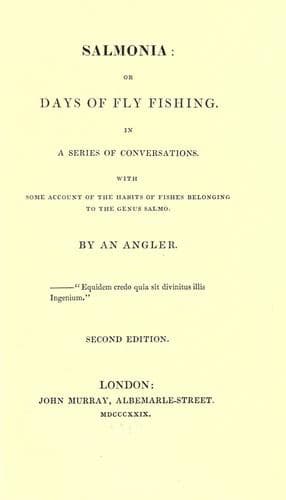
Salmonia; Or, Days of Fly Fishing: In a series of conversations. With some account of the habits of fishes belonging to the genus SalmoDavy, Humphry, Sir
Philosophy
Salmonia; Or, Days of Fly Fishing: In a series of conversations. With some account of the habits of fishes belonging to the genus Salmo
Davy, Humphry, Sir
Fishing
HAL.—He is off; in one of these somersets he detached the steel, and he
now leaps to celebrate his escape. We will leave this place, where there
are more great fish, and return to it after a while, when the alarm
produced by our operations has subsided.
PHYS.—That fish take the artificial fly at all is rather surprising to
me, for in its most perfect form it is but a rude imitation of nature;
and from the greedy manner in which it is seized, fish, I think, cannot
possess a refined sense of smell, or any nervous system corresponding to
the nasal one in animals that breathe air: no scent can be given to
water by an artificial fly, or, at least, none like that of the natural
fly.
HAL.—The principal use of the nostrils in fishes, I believe, is to
assist in the propulsion of water through the gills for performing the
office of respiration, but I think there are some nerves in these organs
which give fishes a sense of the qualities of the water, or of
substances dissolved in, or diffused through it, similar to our sense of
smell, or, perhaps, rather our sense of taste, for there can be no doubt
that fishes are attracted by scented pastes and scented worms, which are
sometimes used by anglers that employ ground-baits; and in old
angling-books there are usually receipts for attracting fish in this
manner, and though the absurdity of many of these prescriptions is
manifest, yet I do not think this proves that they are entirely useless,
for, upon such principles, all the remedies for diseases in the old
pharmacopœias would be null.
With respect to the fly, as it usually touches the stream by a very
small surface, that of the air-bubbles on the fringes on its legs, it
can scarcely affect the water so as to give it any power of
communicating smell. And as you have seen a ripple or motion on the
water is necessary to deceive fishes; and as they look at the fly from
below, they see distinctly only the legs and body, which, when the
colours are like those of the natural fly, may easily deceive them; the
wings, which are the worst imitated parts of the artificial fly, seldom
appear to them, except through the different refractive power of the
moving water and the atmosphere, and when immersed, they form masses not
unlike the wings of a drowned fly, or one wetted in rising.
* * * * *
It is now a quarter of an hour since we left the large pool: let us
return to it; I see the fish are again rising.
POIET.—I am astonished! It appears to me that the very same fish are
again feeding. There are two fish rising nearly in the same spot where
they rose before: can they be the same fish?
HAL.—It is very possible. It is not likely that three other fish of that
size should occupy the same haunts.
POIET.—But I thought after a fish had been hooked, he remained sick and
sulky for some time, feeling his wounds uncomfortable.
Public-domain text, read in full here on John Shaqi.
Reviews
Reviews
No reviews yet
Be the first to share your thoughts on this work.
Join the Discussion
Join the discussion
Sign in to leave a comment or review.
Sign InorCreate an account