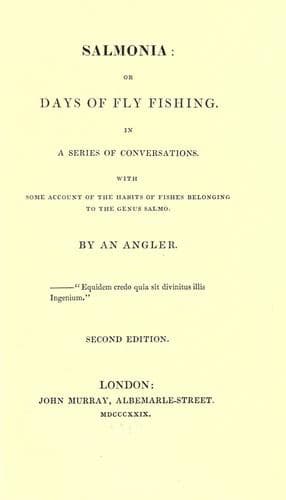
Salmonia; Or, Days of Fly Fishing: In a series of conversations. With some account of the habits of fishes belonging to the genus SalmoDavy, Humphry, Sir
Philosophy
Salmonia; Or, Days of Fly Fishing: In a series of conversations. With some account of the habits of fishes belonging to the genus Salmo
Davy, Humphry, Sir
Fishing
HAL.—The fish that I hooked is not rising in the same place, and
therefore, probably, was hurt by the hook; but one of these fish seems
to be the same that carried off your fly, and it is probable that the
hook only struck him in a part of the mouth where there are no nerves;
and that he suffered little at the moment, and does not now feel his
annoyance.
POIET.—I have seen him take four or five flies: I shall throw over him.
There, he rose, but refused the fly. He has at least learnt, from the
experiment he has made, to distinguish the natural from the artificial
fly.
HAL.—This, I think, always happens after a fish has been hooked with an
artificial fly. He becomes cautious, and is seldom caught that year, at
least with the same means in the same pool: but I dare say that fish
might be taken with a natural fly; or, what is better, two upon the
hook.
POIET.—Pray try him.
HAL.—I am no artist at this kind of angling, but Ornither I know has
fished in June with the clubs at Stockbridge, where this method of
fishing is usual. Pray let him try his fortune, though it is hardly fair
play; and it is rather to endeavour to recover your tackle, than for the
sake of the fish, that I encourage him to make the essay.
POIET.—Pray make no apologies for the trial. Such a fish—certainly a
monster for this river—should be caught by fair means, if possible, but
caught by any means.
ORN.—You lost that fish, and you overrate his size, as you will see, if
I have good luck. I put my live flies on the hook with some regret and
some disgust. I will not employ another person to be my minister of
cruelty, as I remember a lady of fashion once did, who was very fond of
fishing for perch, and who employed her daughter, a little girl of nine
years of age, to pass the hook through the body of the worm! Now there
is a good wind, and the fish has just taken a natural fly. I shall drop
the flies, if possible, within a few inches of his nose. He has risen.
He is caught! I must carry him down stream to avoid the bed of weeds
above. I now have him on fair ground, and he fights with vigour.
Fortunately, my silk worm gut is very strong, for he is not a fish to be
trifled with. He begins to be tired; prepare the net. We have him safe,
and see your link hangs to his lower jaw: the hook had struck the
cartilage on the outside of the bone, and the fly, probably, was
scarcely felt by him.
PHYS.—I am surprised! That fish evidently had discovered that the
artificial fly was a dangerous bait, yet he took the natural fly which
was on a hook, and when the silk-worm gut must have been visible.
HAL.—I do not think he saw either the gut or the hook. In very bright
weather and water, I have known very shy fish refuse even a hook baited
with the natural fly, scared probably by some appearance of hook or gut.
The vision of fishes when the surface is not ruffled is sufficiently
keen. I have seen them rise at gnats so small as to be scarcely visible
to my eye.
Public-domain text, read in full here on John Shaqi.
Reviews
Reviews
No reviews yet
Be the first to share your thoughts on this work.
Join the Discussion
Join the discussion
Sign in to leave a comment or review.
Sign InorCreate an account