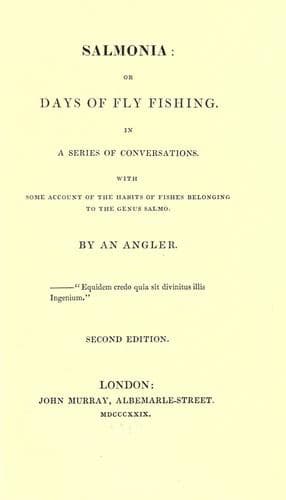
Salmonia; Or, Days of Fly Fishing: In a series of conversations. With some account of the habits of fishes belonging to the genus SalmoDavy, Humphry, Sir
Philosophy
Salmonia; Or, Days of Fly Fishing: In a series of conversations. With some account of the habits of fishes belonging to the genus Salmo
Davy, Humphry, Sir
Fishing
PHYS.—You just now said, that a fish pricked by the hook of an
artificial fly would not usually take it again that season.
HAL.—I cannot be exact on that point: I have known a fish that I have
pricked retain his station in the river, and refuse the artificial fly,
day after day, for weeks together; but his memory may have been kept
awake by this practice, and the recollection seems local and associated
with surrounding objects; and if a pricked trout is chased into another
pool, he will, I believe, soon again take the artificial fly. Or if the
objects around him are changed, as in Autumn, by the decay of weeds, or
by their being cut, the same thing happens; and a flood, or a rough
wind, I believe, assists the fly-fisher, not merely by obscuring the
vision of the fish, but, in a river much fished, by changing the
appearance of their haunts: large trouts almost always occupy particular
stations, under, or close to, a large stone or tree; and, probably, most
of their recollected sensations are connected with this dwelling.
PHYS.—I think I understand you, that the memory of the danger and pain
does not last long, unless there is a permanent sensation with which it
can remain associated,—such as the station of the trout; and that the
recollection of the mere form of the artificial fly, without this
association, is evanescent.
ORN.—You are diving into metaphysics; yet I think, in fowling, I have
observed that the memory of birds is local. A woodcock, that has been
much shot at and scared in a particular wood, runs to the side where he
has usually escaped, the moment he hears the dogs; but if driven into a
new wood, he seems to lose his acquired habits of caution, and becomes
stupid.
POIET.—This great fish, that Ornither has just caught, must be nearly of
the weight I assigned to him.
HAL.—O no! he is, I think, above 5lbs., but not 6lbs.; but we can form a
more correct opinion by measuring him, which I can easily do, the but of
my rod being a measure. He measures, from nose to fork, a very little
less than twenty-four inches, and, consequently, upon the scale which is
appropriate to well-fed trouts, should weigh 5lbs. 10oz.—which, within
an ounce, I doubt not, is his weight.
PHYS.—O! I see you take the mathematical law, that similar solids are to
each other in the triplicate ratio of one of their dimensions.
HAL.—You are right.
PHYS.—But I think you are below the mark, for this appears to me an
extraordinarily thick fish.
HAL.—He is a well-fed fish, but, in proportion, not so thick as my
model, which was a fish of 17 inches by 9 inches, and weighed 2lbs.;
this is my standard solid. We will try him. Ho! Mrs. B.!—bring your
scales, and weigh this fish. There, you see, he weighs 5lbs. 10½oz.
PHYS.—Well, I am pleased to see this fish, and amused with your sport;
but though I have been imitating you in throwing the fly, as well as I
can, yet not a trout has taken notice of my fly, and they seem scared by
my appearance.
Public-domain text, read in full here on John Shaqi.
Reviews
Reviews
No reviews yet
Be the first to share your thoughts on this work.
Join the Discussion
Join the discussion
Sign in to leave a comment or review.
Sign InorCreate an account