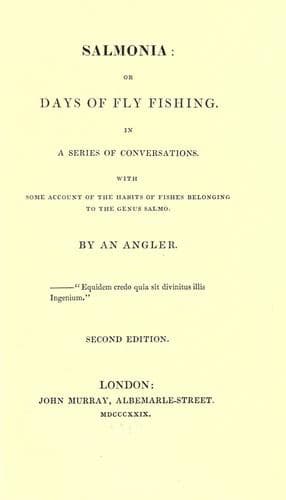
Salmonia; Or, Days of Fly Fishing: In a series of conversations. With some account of the habits of fishes belonging to the genus SalmoDavy, Humphry, Sir
Philosophy
Salmonia; Or, Days of Fly Fishing: In a series of conversations. With some account of the habits of fishes belonging to the genus Salmo
Davy, Humphry, Sir
Fishing
HAL.—You know that trout spawn or deposit their ova and seminal fluid in
the end of the autumn or beginning of winter, from the middle of
November till the beginning of January, their maturity depending upon
the temperature of the season, their quantity of food, &c. For some time
(a month or six weeks) before they are prepared for the sexual function,
or that of re-production, they become less fat, particularly the
females; the large quantity of eggs and their size probably affecting
the health of the animal, and compressing generally the vital organs in
the abdomen. They are at least six weeks or two months after they have
spawned before they recover their flesh: and the time when these fish
are at the worst is likewise the worst time for fly-fishing, both on
account of the cold weather and because there are fewer flies on the
water than at any other season. Even in December and January there are a
few small gnats or water-flies on the water in the middle of the day, in
bright days, or when there is sunshine. These are generally black, and
they escape the influence of the frost by the effects of light on their
black bodies, and probably by the extreme rapidity of the motions of
their fluids, and generally of their organs. They are found only at the
surface of the water, where the temperature must be above the freezing
point. In February a few double-winged water-flies which swim down the
stream are usually found in the middle of the day,—such as the
willow-fly; and the cow-dung-fly is sometimes carried on the water by
winds. In March there are several flies found on most rivers. The
grannam or green-tail-fly, with a wing like a moth, comes on generally
morning and evening, from five till eight o’clock, A. M. in mild weather
in the end of March and through April. Then there are the blue and the
brown, both Ephemeræ, which come on, the first in dark days, the second
in bright days; these flies, when well imitated, are very destructive to
fish. The first is a small fly with a palish-yellow body, and slender
beautiful wings, which rest on the back as it floats down the water. The
second, called the cob in Wales, is three or four times as large, and
has brown wings, which likewise protrude from the back, and its wings
are shaded like those of a partridge, brown and yellow brown. These
three kinds of flies lay their eggs in the water, which produce larvæ
that remain in the state of worms, feeding and breathing in the water
till they are prepared for their metamorphosis and quit the bottoms of
the rivers, and the mud and stones, for the surface, and the light and
air. The brown fly usually disappears before the end of April, likewise
the grannam; but of the blue dun, there is a succession of different
tints, or species, or varieties, which appear in the middle of the day
all the summer and autumn long. These are the principal flies on the
Wandle—the best and clearest stream near London. In early spring these
Public-domain text, read in full here on John Shaqi.
Reviews
Reviews
No reviews yet
Be the first to share your thoughts on this work.
Join the Discussion
Join the discussion
Sign in to leave a comment or review.
Sign InorCreate an account