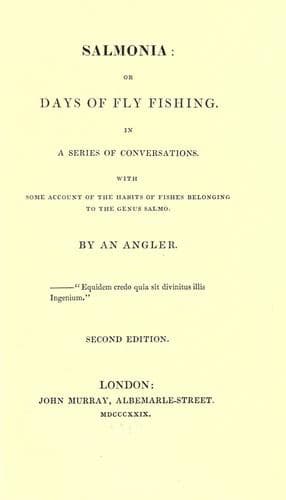
Salmonia; Or, Days of Fly Fishing: In a series of conversations. With some account of the habits of fishes belonging to the genus SalmoDavy, Humphry, Sir
Philosophy
Salmonia; Or, Days of Fly Fishing: In a series of conversations. With some account of the habits of fishes belonging to the genus Salmo
Davy, Humphry, Sir
Fishing
flies have dark olive bodies; in the end of April and the beginning of
May they are found yellow; and in the summer they become
cinnamon-coloured; and again, as the winter approaches, gain a darker
hue. I do not, however, mean to say that they are the same flies, but
more probably successive generations of Ephemeræ of the same species.
The excess of heat seems equally unfavourable, as the excess of cold, to
the existence of the smaller species of water-insects, which, during the
intensity of sunshine, seldom appear in summer, but rise morning and
evening only. The blue dun has in June and July a yellow body, and there
is a water-fly which in the evening is generally found before the moths
appear, called the red-spinner. Towards the end of August, the Ephemeræ
appear again in the middle of the day: a very pale small Ephemera, which
is of the same colour as that which is seen in some rivers in the
beginning of July. In September and October this kind of fly is found
with an olive body, and it becomes darker in October, and paler in
November. There are two other flies which appear in the end of
September, and continue during October if the weather be mild: a large
yellow fly with a fleshy body and wings like a moth; and a small fly
with four wings, with a dark or claret-coloured body, that when it falls
on the water has its wings like the great yellow fly, flat on its back.
This, or a claret-bodied fly, very similar in character, may be likewise
found in March or April, on some waters. In this river I have often
caught many large trout in April and the beginning of May, with the blue
dun, having the yellow body; and in the upper part of the stream below
St. Albans, and between that and Watford, I have sometimes, even as
early as April, caught fish in good condition: but the _true_ season for
the Colne is the season of the May-fly. The same may be said of most of
the large English rivers containing large trouts, and abounding in
May-fly;—such as the Test and the Kennet; the one running by
Stockbridge, the other by Hungerford. But in the Wandle at Carshalton
and Beddington, the May-fly is not found; and the little blues are the
constant, and when well imitated, killing flies on this water; to which
may be joined a dark alder-fly, and a red evening fly. In the Avon, at
Ringwood and Fordingbridge, the May-fly is likewise a killing fly; but
as this is a grayling river, the other flies, particularly the grannam
and blue and brown, are good in spring, and the alder-fly or pale blue
later, and the blue dun in September and October, and even November. In
the streams in the mountainous parts of Britain, the spring and autumnal
flies are by far the most killing. The Usk was formerly a very
productive trout stream, and the fish being well-fed by the worms washed
down by the winter floods, were often in good season, cutting red, in
March, and the beginning of April: and at this season the blues and
Public-domain text, read in full here on John Shaqi.
Reviews
Reviews
No reviews yet
Be the first to share your thoughts on this work.
Join the Discussion
Join the discussion
Sign in to leave a comment or review.
Sign InorCreate an account