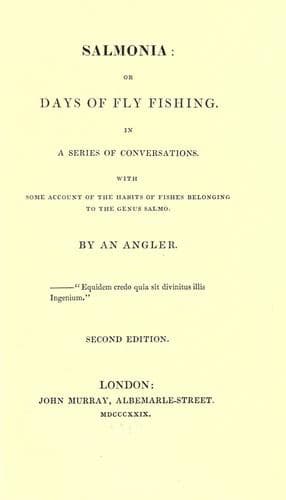
Salmonia; Or, Days of Fly Fishing: In a series of conversations. With some account of the habits of fishes belonging to the genus Salmo — John Shaqi
Salmonia; Or, Days of Fly Fishing: In a series of conversations. With some account of the habits of fishes belonging to the genus SalmoDavy, Humphry, Sir
Philosophy
Salmonia; Or, Days of Fly Fishing: In a series of conversations. With some account of the habits of fishes belonging to the genus Salmo
Davy, Humphry, Sir
Fishing
ORN.—I have seen this fish in the rivers of Wales and Herefordshire, and
have heard it asserted, on what appeared to me good authority, that it
was a mule,—the offspring of a trout and a salmon.
HAL.—This opinion, I know, has been supported by the fact, that it is
found only in streams, which are occasionally visited by salmon; yet I
know no direct evidence in favour of the opinion, and I should think it
much more probable, if it be a mixed race, that it is produced by the
sea trout and common trout. In a small river, which runs into the Moy,
near Ballina in Ireland, I once caught in October a great number of
small sea trout, which were generally about half-a-pound in weight, and
were all _males_; and unless it be supposed, that the females were in
the river likewise, and would not take the fly, these fish, in which the
spermatic system was fully developed, could only have impregnated the
ova of the common river trout. The sea trout and river trout are,
indeed, so like each other in character, that such a mixture seems
exceedingly probable; but I know no reason why such mules should always
continue small, except that it may be a mark of imperfection. The only
difference between the par and common small trout is in the colours, and
its possessing one or two spines more in the pectoral fin. The par has
large blue or olive bluish marks on the sides, as if they had been made
by the impression of the fingers of a hand; and hence the fish is called
in some places _fingerling_. The river and sea trout seem capable of
changing permanently their places of residence; and sea trout appear
often to become river trout. In this case they lose their silvery
colour, and gain more spots; and in their offspring these changes are
more distinct. Fish, likewise, which are ill-fed remain small; and pars
are exceedingly numerous in those rivers where they are found, which are
never separated from the sea by impassable falls; from which I think it
possible that they are produced by a cross between sea and river trout.
The varieties of the common trout are almost infinite; from the great
lake trout, which weighs above 60 or 70lbs., to the trouts of the little
mountain brook or small mountain lake, or tarn, which is scarcely larger
than the finger. The smallest trout spawn nearly at the same time with
the larger ones, and their ova are of the same size; but in the large
trout there are tens of thousands, and in the small one rarely as many
as forty,—often from ten to forty. So that in the physical constitution
of these animals, their production is diminished as their food is small
in quantity; and it is remarkable, that the ova of the large and
beautiful species which exist in certain lakes, and which seem always to
associate together, appear to produce offspring, which, in colour, form,
and power of growth and reproduction, resemble the parent fishes; and
they generally choose the same river for their spawning. Thus, in the
Public-domain text, read in full here on John Shaqi.
Reviews
Reviews
No reviews yet
Be the first to share your thoughts on this work.
Join the Discussion
Join the discussion
Sign in to leave a comment or review.
Sign InorCreate an account