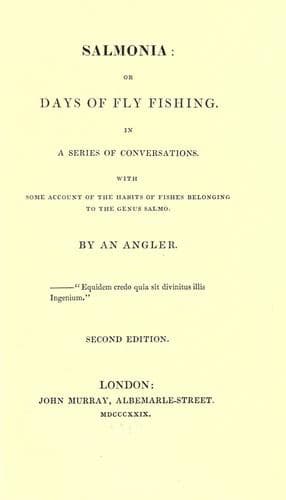
Salmonia; Or, Days of Fly Fishing: In a series of conversations. With some account of the habits of fishes belonging to the genus Salmo — John Shaqi
Salmonia; Or, Days of Fly Fishing: In a series of conversations. With some account of the habits of fishes belonging to the genus SalmoDavy, Humphry, Sir
Philosophy
Salmonia; Or, Days of Fly Fishing: In a series of conversations. With some account of the habits of fishes belonging to the genus Salmo
Davy, Humphry, Sir
Fishing
and the consequence is, that they are more likely to be affected by
severe droughts and great floods—the first killing, and the second
washing away the larvæ and aurelias. May-flies thirty years ago were
abundant in the upper part of the Teme river in Herefordshire, where it
receives the Clun: they are now rarely seen. Most of the rivers of that
part of England, as well as of the west, with the exception of those
that rise in the still uncultivated parts of Dartmoor and Exmoor, are
rapid and unfordable torrents after rain, and in dry summers little more
than scanty rills; and Exmoor and Dartmoor, almost the only considerable
remains of those moist, spongy, or peaty soils, which once covered the
greatest part of the high lands of England, are becoming cultivated, and
their sources will gradually gain the same character as those of our
midland and highly-improved counties. I cannot give you an idea of the
effects of peat mosses and grassy marshes on the water thrown down from
the atmosphere, better, than by comparing their effects to those of
roofs of houses of thatched straw, as contrasted with roofs of slate, on
a shower of rain. The slate begins to drop immediately, and sends down
what it receives in a rapid torrent, and is dry soon after the shower is
over. From the sponge-like roof of thatch, on the contrary, it is long
before the water drops; but it continues dropping and wet for hours
after the shower is over and the slate dry.
POIET.—You spoke just now of the gillaroo trout, as belonging only to
Ireland. I can, however, hardly bring myself to believe, that such a
fish is not to be found elsewhere. For lakes with shell-fish and char
are common in various parts of Europe, and as the gillaroo trout is
congenerous, it ought to exist both in Scotland and the Alpine
countries.
HAL.—It is not possible from analogies of this kind to draw certain
inferences. Subterraneous cavities and subterranean waters are common in
various countries, yet the Proteus Anguinus is only found in two places
in Carniola—at Adelsburg and Sittich. As I mentioned before, I have
never yet met with a gillaroo trout except in Ireland. It is true, it is
only lately that I have had my attention directed to this subject, and
other fishermen or naturalists may be more fortunate.
POIET.—Have you ever observed any other varieties of the trout kind,
which may be considered as, like the gillaroo, forming a distinct
species?
HAL.—I think the par, samlet, or brandling, common to most of our
rivers, which communicate with the sea, has a claim to be considered a
distinct species; yet the history of this fish is so obscure, and so
little understood, that, perhaps, I ought not to venture to give an
account of it. But in doing so, you will consider me as rather asking
for new information, than as attempting a satisfactory view of this
little animal.
Public-domain text, read in full here on John Shaqi.
Reviews
Reviews
No reviews yet
Be the first to share your thoughts on this work.
Join the Discussion
Join the discussion
Sign in to leave a comment or review.
Sign InorCreate an account