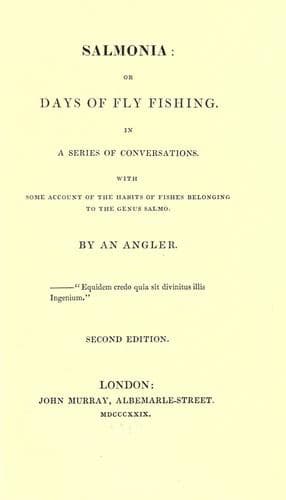
Salmonia; Or, Days of Fly Fishing: In a series of conversations. With some account of the habits of fishes belonging to the genus SalmoDavy, Humphry, Sir
Philosophy
Salmonia; Or, Days of Fly Fishing: In a series of conversations. With some account of the habits of fishes belonging to the genus Salmo
Davy, Humphry, Sir
Fishing
HAL.—I think it must be another species of the same genus; the same as
Back’s grayling found by Captain Franklin and his companions in North
America, and distinguished by a much larger back fin. Having travelled
with the fishing-rod in my hand through most of the Alpine valleys in
the south and east of Europe, and some of those in Norway and Sweden, I
have always found the char in the coldest and highest waters; the trout,
in the brooks rising in the highest and coldest mountains; and the
grayling always lower, where the temperature was milder: and if in hot
countries, only at the foot of mountains, not far from sources which had
the mean temperature of the atmosphere,—as in the Vipacco, near
Goritzia, and in the streams which gush forth from the limestone caverns
of the Nordic Alps. Besides temperature, grayling require a peculiar
character in the disposition of the water of rivers. They do not dwell,
like trout, in rapid shallow torrents; nor, like char or chub, in deep
pools or lakes. They require a combination of stream and pool; they like
a deep still pool for rest, and a rapid stream above, and a gradually
declining shallow below, and a bottom where marl or loam is mixed with
gravel; and they are not found abundant except in rivers that have these
characters. It is impossible to have a more perfect specimen of a
grayling river than that now running before us, in this part of its
course. You see a succession of deep still pools under shady banks of
marl, with gentle rapids above, and a long shelving tail, where the fish
sport and feed. Should there be no such pools in a river, grayling would
remain, provided the water was clear, and would breed; but they cannot
stem rapid streams, and they are gradually carried down lower and lower,
and at last disappear. You know the Test, one of the finest trout
streams in Hampshire, and of course in England; when I first knew this
stream, twenty years ago, there were no grayling in it. A gentleman
brought some from the Avon, and introduced them into the river at
Longstock, above Stockbridge. They were for two or three years very
abundant in that part of the river; but they gradually descended, and
though they multiplied greatly, there are now scarcely any above
Stockbridge. There were, four years ago, many in the river just below;
but this year there are very few there, and the great proportion that
remains is found below Houghton. I ought to mention, that the water is
particularly fitted for them, and they become larger in this river than
in their native place, the Avon,—some of them weighing between 3 and
4lbs. The trout, in all its habits of migration, runs upward, seeking
the fresh and cool waters of mountain sources to spawn in: the grayling,
I believe, has never the same habit of running up stream; I never saw
one leaping at a fall, where trout are so often seen. Their large back
fin seems intended to enable them to rise and sink rapidly in deep
Public-domain text, read in full here on John Shaqi.
Reviews
Reviews
No reviews yet
Be the first to share your thoughts on this work.
Elsewhere in the archive
Join the Discussion
Join the discussion
Sign in to leave a comment or review.
Sign InorCreate an account