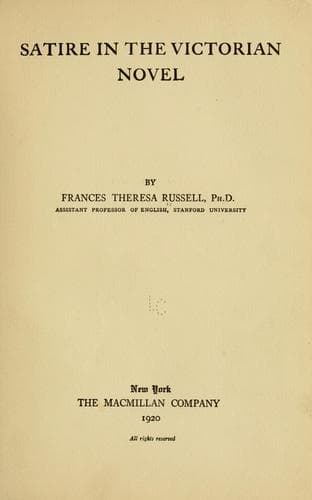
Satire in the Victorian novelRussell, Frances Theresa
History
Satire in the Victorian novel
Russell, Frances Theresa
English fiction -- 19th century -- History and criticism; Satire, English -- History and criticism; Thesis (Ph. D.)
Disraeli, whose career paralleled Lytton’s in several ways, takes the
same tone toward his own social environment, but his deeper political
earnestness led him to criticise that environment in the wider as well
as narrower social sense. In his first real novel we find the latter by
itself, in such touches as this:[283]
“Always in the best set, never flirting with the wrong man, and
never speaking to the wrong woman, all agreed that the Ladies
Saint Maurice had fairly won their coronets.”
Again it appears in this account of the hero:[284]
“The banquet was over: the Duke of Saint James passed his
examination with unqualified approval; and having been stamped
at the Mint of Fashion as a sovereign of the brightest die,
he was flung forth, like the rest of his golden brethren, to
corrupt the society of which he was the brightest ornament.”
The house-party of the Dacres, a family of taste and high standards, is
described negatively:[285]
“* * * no duke who is a gourmand, no earl who is a jockey, no
manœuvering mother, no flirting daughters, no gambling sons, for
your entertainment, * * * As for buffoons and artists, to amuse
a vacant hour or sketch a vacant face, we must frankly tell you
at once that there is not one.”
But from _Popanilla_ through the Trilogy the inanity and pretense
of this social circle is made more pointed by contrast with those
socially beneath it. Egremont’s experience with the plain people
induces this serious indictment of his own set:[286]
“It is not merely that it is deficient in warmth and depth
and breadth; that it is always discussing persons instead
of principles, * * * it is not merely that it has neither
imagination, nor fancy, nor sentiment, nor feeling, nor
knowledge, to recommend it, but * * * it is in short, trivial,
uninteresting, stupid, really vulgar.”
Thackeray also speaks from within, and has to his credit his great
roster of Snobs, his panoramic Vanity Fair, and his imposing
procession of worldly, heartless, noble old dames. Trollope prefers
country life, but his Claverings, de Courcys, Luftons, and the Duke of
Omnium, show that he has no desire to neglect its aristocracy. Dickens,
on the other hand, loved London and its struggling poor, but in the
Merdles, the Veneerings, and the Dorrits _redivivi_, he does what he
can with the humors of the struggling rich.
To Meredith the exasperating thing about polite society was its
impoliteness,--its delight in gossip and scandal, its petty but
venomous persecutions, and the false courtesy that takes refuge in
conventionality. This impression apparently deepened with time, for
it is glimpsed only in _Evan Harrington_ and _Sandra Belloni_, of the
earlier books, but is entirely absent from none of the last half dozen.
Public-domain text, read in full here on John Shaqi.
Reviews
Reviews
No reviews yet
Be the first to share your thoughts on this work.
Elsewhere in the archive
Join the Discussion
Join the discussion
Sign in to leave a comment or review.
Sign InorCreate an account