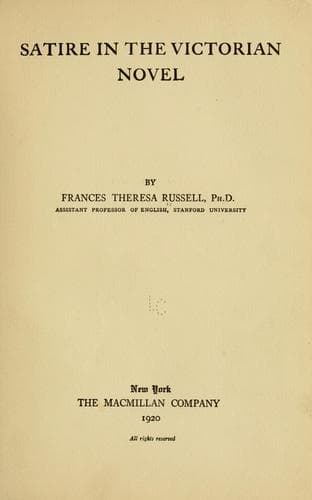
Satire in the Victorian novelRussell, Frances Theresa
History
Satire in the Victorian novel
Russell, Frances Theresa
English fiction -- 19th century -- History and criticism; Satire, English -- History and criticism; Thesis (Ph. D.)
Butler, preoccupied with other subjects, takes time for only one good
shot at this, but that one is so good that it forms a fitting climax.
He mentions casually an Erewhonian custom, which may be taken as
symbolic of that country’s social behavior and philosophy:[287]
“When any one dies, the friends of the family * * * send little
boxes filled with artificial tears, and with the name of the
sender painted neatly upon the outside of the lid. The tears
vary in number from two to fifteen or sixteen, according to the
degree of intimacy or relationship; and people sometimes find
it a nice point of etiquette to know the exact number which
they ought to send. Strange as it may appear, this attention is
highly valued, and its omission by those from whom it might be
expected is keenly felt. These tears were formerly stuck with
adhesive plaster to the cheeks of the bereaved, and were worn in
public for a few months after the death of a relative; they were
then banished to the hat or bonnet, and are now no longer worn.”
Whether the last clause may be viewed as a hopeful augury for the
future, the author does not state.
The step from the society of the drawing room to society at large, or
mankind, is a refreshing passage from indoors, where everything is
artificial, even the tears of bereavement, to the fresh air of common
interest. The weather may not always be serene nor the atmosphere
invigorating, but at least there is a wide horizon and a perspective of
some scope. It is evident that the Victorians enjoyed these excursions
into the masculine domain of Government, for not one of the list
forbade his mind to roam into its boundaries, and not one is wholly
silent as to the impressions gained by this adventuring. Here the
resemblance ends. Interest in public problems and The People varies
from a minimum in Thackeray and George Eliot to a maximum in Peacock,
Disraeli, and Butler. There is also great diversity in both breadth and
intensity. Lytton, Dickens, Trollope, have several irons in the fire.
Gaskell, Brontë, Reade, Kingsley, have but one or two, but the heat is
none the less fervent. In some cases, indeed, it is too fervent to give
off the sparkle of ridicule, and thus falls without our province. And
in some cases, while it is meant seriously as propaganda, it cannot be
taken seriously as literature; for the artist is not expected to speak
with the tongue of statesmen and economists, and conversely, as Dowden
reminds us, “a political manifesto in three volumes is not a work of
art.”[288]
Neither of these strictures applies to Peacock, who launches the
subject for us in a pungent description of the good old days of Celtic
antiquity:[289]
Public-domain text, read in full here on John Shaqi.
Reviews
Reviews
No reviews yet
Be the first to share your thoughts on this work.
Elsewhere in the archive
Join the Discussion
Join the discussion
Sign in to leave a comment or review.
Sign InorCreate an account