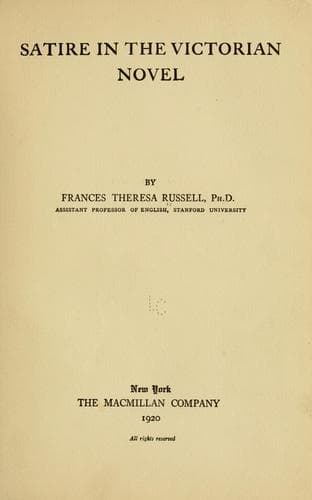
Satire in the Victorian novelRussell, Frances Theresa
History
Satire in the Victorian novel
Russell, Frances Theresa
English fiction -- 19th century -- History and criticism; Satire, English -- History and criticism; Thesis (Ph. D.)
“Political science they had none. * * * Still they went to work
politically much as we do. The powerful took all they could
get from their subjects and neighbors; and called something or
other sacred and glorious when they wanted the people to fight
for them. They repressed disaffection by force, when it showed
itself in an overt act; but they encouraged freedom of speech,
when it was, like Hamlet’s reading, ‘words, words, words.’”
In the same story, the episode of the decaying embankment, with its
parody of Lord Canning’s Defense of the British Constitution, and
the satire on the game laws, set the pace for the subsequent thrusts
at Toryism and the country squires, particularly Meredith’s, whom
he naturally influenced. Demagogic bamboozlement of the public is
punctured again in the speech of Mr. Paperstamp:[290]
“We shall make out a very good case; but you must not forget to
call the present public distress an awful dispensation; a little
pious cant goes a great way towards turning the thoughts of men
from the dangerous and Jacobinical propensity of looking into
moral and political causes for moral and political effects.”
It is in _Melincourt_ also that the campaign of Mr. Oran Hautton in
the Borough of Onevote starts the satiric ball rolling into election
camps,--later pushed along by the authors of _Pelham_, _The Newcomes_,
_Doctor Thome_, _Felix Holt_, _Middlemarch_, and _Beauchamp’s Career_.
Although Lytton started out as a Liberal, he ended as a Conservative,
and furnishes some counter satire against democracy. In _Night and
Morning_ he speaks of men losing their democratic enthusiasm; and in
_The Coming Race_ he gives proof that his is entirely lost. The family
of the narrator are Americans, “rich and aristocratic, therefore
disqualified for public service;” his father, defeated by his tailor
in the race for Congress, decides on the superior beauty of private
life. The Vrilya have a very expressive compound word. _Koom_ means a
profound hollow; _Posh_ is a term of utter contempt; “_Koom-Posh_ is
their name for the government of the many, or the ascendency of the
most ignorant and hollow.”[291] This contempt, distributed impartially
over dishonest demagogue and gullible public, is nothing new. Smollett,
for instance, in his _Adventures of an Atom_, appreciates the art of
oratory:
“Our orator was well acquainted with all the legerdemain of his
own language, as well as with the nature of the beast he had to
rule. He knew when to distract its weak brain with a tumult of
incongruous and contradictory ideas: he knew when to overwhelm
its feeble faculty of thinking, by pouring in a torrent of words
without any ideas annexed.”
Public-domain text, read in full here on John Shaqi.
Reviews
Reviews
No reviews yet
Be the first to share your thoughts on this work.
Elsewhere in the archive
Join the Discussion
Join the discussion
Sign in to leave a comment or review.
Sign InorCreate an account