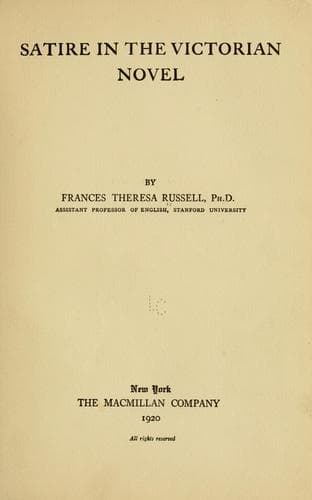
Satire in the Victorian novelRussell, Frances Theresa
History
Satire in the Victorian novel
Russell, Frances Theresa
English fiction -- 19th century -- History and criticism; Satire, English -- History and criticism; Thesis (Ph. D.)
When the tale of twentieth century satire shall be told, considerable
space will have to be devoted to Militarism versus Pacifism. But the
Victorians lived, if not in piping times of peace, at least in a time
reasonably peaceful, for their island heard little but echoes of the
European cannon; a condition which tended to keep men’s minds at home
and occupied with internal affairs. The satirists therefore have little
to say about war. Peacock unveils the policy of launching a foreign war
in order to smother discontent over domestic troubles. In such stories
as _Shirley_, _Silas Marner_, and others located in or soon after the
Napoleonic Era, are scattered parenthetical remarks; as for instance
the opening scene of _An Amazing Marriage_, “when crowned heads were
running over Europe, crying out for charity’s sake to be amused after
their tiresome work of slaughter; and you know what a dread they have
of moping.” In Disraeli’s _Ixion_, Mars is not popular in Olympian
circles, being despised as “a brute, more a bully than a hero. Not
at all in the best set.” Accordingly, since, as we are reminded by
Phillips in his _Modern Europe_, “the British lion, turned ruminant,
had been browsing in the pleasant pastures of peace to the melodious
piping of Bright and Cobden,” and since it had, when required, the less
melodious taunting of Carlyle, it needed at this time no Aristophanes
or Swift to mock at the madness of militarism.
In organized religion we see a paradoxical and yet natural enough
operation of mortal psychology. In its primitive origin it sprang from
two opposite sources, human innocence and human craft. In his innocence
man believed that his immortal life must put on mortality, become
incarnate in architecture, creed, ritual, before it could be lived.
And in his craft he discovered that the incorruptible could be made to
put on corruption,--to the great advantage of an entirely terrestrial
ambition. These two factors, conjoined with the ubiquitous impulse to
socialize feelings and thoughts as well as actions, have succeeded in
so clothing and housing the wistful spirit which for itself asks no
more than an assurance of some divinity dwelling without or within
us, that its elaborate trappings and conspicuous paraphernalia have
become shining marks for those who see the possible absurdity in this
materializing of the spiritual.
Until recently, however, few shafts have penetrated to the heart of the
discrepancy. Most of them have been aimed at the broad and inviting
surface of obvious inconsistencies: indulgence in material luxury on
the part of an institution founded to further the spiritual life;
dominance of authority in a realm that should be free; flourishing of
bigotry, greed, cruelty, hypocrisy, in the exclusive garden of all the
virtues; unlovely partisan disputes and recriminations in connection
with the one thing that best can symbolize the brotherhood of man.
Public-domain text, read in full here on John Shaqi.
Reviews
Reviews
No reviews yet
Be the first to share your thoughts on this work.
Elsewhere in the archive
Join the Discussion
Join the discussion
Sign in to leave a comment or review.
Sign InorCreate an account