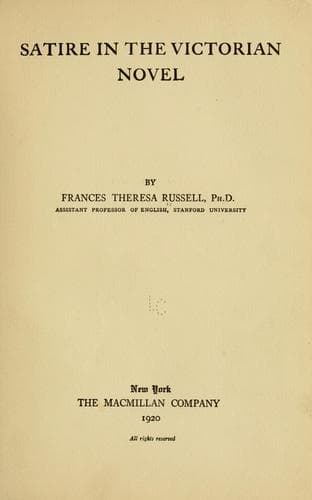
Satire in the Victorian novelRussell, Frances Theresa
History
Satire in the Victorian novel
Russell, Frances Theresa
English fiction -- 19th century -- History and criticism; Satire, English -- History and criticism; Thesis (Ph. D.)
The distinction must here be made between the official representatives
of the Church as such representatives, and as mere human beings. In
this discussion therefore clergymen are not cited as cases in point
unless they are clearly meant by their authors to be taken as clergy
and not as men.
The Chadband of Dickens, for instance, and the Bute Crawley and Charles
Honeyman of Thackeray, stand on their own feet, and share the common
lot of satirized humanity; neither of these novelists having an arrow
from his full quiver for the Church itself. Nor has Mrs. Gaskell,
though her _North and South_ hinges on the tragedy of Mr. Dale, an
Anglican minister turned Dissenter. George Eliot spares likewise the
Institution she had herself outgrown. Her Clerical Lives, her Reverends
Irwine and Lyon, such diverse types as the modest Dinah Morris and the
dominating Savonarola, are treated sympathetically, as is also the
pitiful fanaticism of Lantern Yard. Lytton and Reade too grant the
consent implied in silence. But other half speak out, briefly or at
length.
Peacock is most impressed with the uselessness of an institution which
seems to exist for the gratification of its dignitaries. The candid
Mr. Sarcastic, after horrifying Miss Pennylove on the question of
auctioning off brides, proceeds in his frank career:[312]
“I irreparably offended the Reverend Dr. Vorax by telling him,
that having a nephew, whom I wished to shine in the church,
I was on the lookout for a luminous butler, and a cook of
solid capacity, under whose joint tuition he might graduate.
‘Who knows,’ said I, ‘but he may immortalize himself at the
University, by giving his name to a pudding?’”
In his medieval tale he takes up the Church as an institution, with
his favorite, backhanded, historical thrust. The Saxons, it seems, had
attacked the Bangor monastery and killed twelve hundred monks:[313]
“This was the first overt act in which the Saxons set forth
their new sense of a religion of peace. It is alleged, indeed,
that these twelve hundred monks supported themselves by the
labour of their own hands. If they did so, it was, no doubt,
a gross heresy; but whether it deserved the castigation it
received from Saint Augustin’s proselytes, may be a question in
polemics. * * * The rabble of Britons must have seen little more
than the superficial facts that the lands, revenues, privileges,
and so forth, which once belonged to Druids and so forth, now
belonged to abbots, bishops, and so forth, who, like their
extruded precursors, walked occasionally in a row, chanting
unintelligible words, and never speaking in common language but
to exhort the people to fight; having, indeed, better notions
than their predecessors of building, apparel, and cookery; and a
better knowledge of the means of obtaining good wine, and of the
final purpose for which it was made.”
To such as this we have Thackeray’s counter-blast, with
admonition,--[314]
Public-domain text, read in full here on John Shaqi.
Reviews
Reviews
No reviews yet
Be the first to share your thoughts on this work.
Elsewhere in the archive
Join the Discussion
Join the discussion
Sign in to leave a comment or review.
Sign InorCreate an account