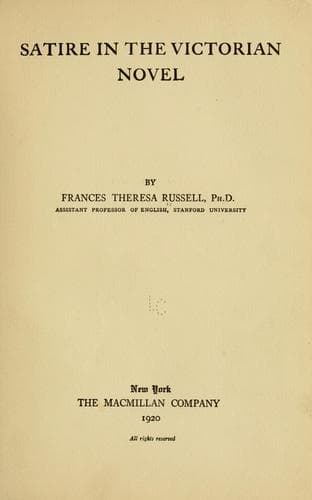
Satire in the Victorian novelRussell, Frances Theresa
History
Satire in the Victorian novel
Russell, Frances Theresa
English fiction -- 19th century -- History and criticism; Satire, English -- History and criticism; Thesis (Ph. D.)
Yet those desirable factors of art, unity and emphasis, must be
secured, and they can be secured only by throwing the emphasis on some
one feature, thus giving unity to the character. In the field of satire
a classification based on these qualities is the more easily made in
that any given character is usually satirized for some particular
trait, although the problem does not end there. We may construct
encampments for our army of characters--and in Victorian fiction they
come in battalions--and we may label them; but we shall find it less
simple to assign the companies to their own barracks and keep them
there.
The Father of the Marshalsea is a snob. He is also hypocritical and
foolish. Moreover, he is a sentimentalist and an epicurean. Withal he
is not villainous, but more pathetic than execrable. He has no apparent
kinship with the Countess de Saldar, yet she also may be described in
the above terms. The enumeration would not show the difference. Thus
not only does each real character refuse to be known by one name and
one only, but the congregation assembled under any one denomination
shows such diversity as to make the category itself questionable.
Mrs. Mackensie and Mrs. Clennam, Mr. Dombey and Bertie Stanhope, Tom
Tulliver and Sir Willoughby Patterne, are all egoists; but they would
find little congeniality in their mutual egoism.
All that can be done is to indicate the range and the concentration of
the main types. These types will of course represent those elements
in human character which seem to the satirist such deflections from
an ideal as are amenable to comic exposure and perhaps correction. It
does not seem possible to reduce them to fewer than seven or eight
heads, as follows: hypocrisy, folly, snobbishness, sentimentality,
egoism, fanaticism, and vulgarity.
These various fields have their specialists. Hypocrisy, including
sycophancy and deliberate imposture of any kind, belongs to Dickens,
with Thackeray, Trollope, and others following not far behind. He leads
also in depiction of folly and incompetence, though these prevail
widely in Victorian fiction; and Meredith excels in portrayal of mental
incapacity and fallacy in reasoning. It is the latter who comes to the
front with sentimentality and egoism, having but few predecessors.
Thackeray handles snobbishness in all its ramifications of worldliness
and elegant _ennui_. But although he contributes the name, the thing
exists on the pages of Lytton, Disraeli, Trollope, and Dickens.
Fanaticism, bigotry, all sorts of fads, make another common ground
for Peacock and Butler, and crop up in Reade, Brontë, and Kingsley.
Coarse vulgarity is the rarest of all, the Age of Propriety refusing
to transplant this weed from life to literature, but it is admitted by
Dickens, Thackeray, Reade, and Trollope.
Public-domain text, read in full here on John Shaqi.
Reviews
Reviews
No reviews yet
Be the first to share your thoughts on this work.
Elsewhere in the archive
Join the Discussion
Join the discussion
Sign in to leave a comment or review.
Sign InorCreate an account