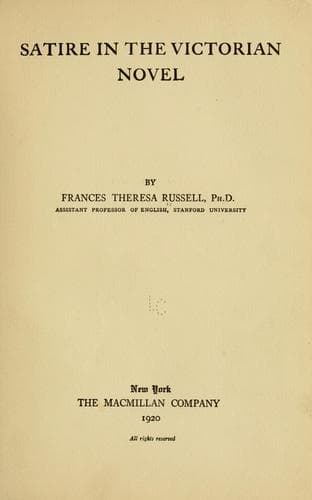
Satire in the Victorian novelRussell, Frances Theresa
History
Satire in the Victorian novel
Russell, Frances Theresa
English fiction -- 19th century -- History and criticism; Satire, English -- History and criticism; Thesis (Ph. D.)
Since satire is usually directed against the special thing in which the
satirist feels superior, we may deduce the favorite Victorian virtues
to have been sincerity, wisdom, rationality, refinement, and a sense
of proportion; a large order, but the nineteenth century would scorn a
smaller.
Dickens did not invent the hypocrite, nor did he supply anything new
to the investigation of the nature of this most subtile of all the
beasts of the field. He himself had not the subtlety to search out
causes and discover possible extenuations and values in a thing he
simply and flatly abhorred and saw no excuse for. What he does furnish
is an immense amount of data, with many variations, showing _in
extenso_ this aspect of human nature. At least three dozen of his three
hundred characters exhibit the seamy side of scheming and deceit. From
_Pickwick_, wherein Mr. Winkle, unfrocked as to skates and branded as
a humbug and an impostor because he assumed an accomplishment when he
had it not, to _Edwin Drood_, harboring Luke Honeythunder, professional
philanthropist, who, “Always something in the nature of a Boil upon the
face of society, * * * expanded into an inflammatory Wen in Minor Canon
Corner,” no volume is entirely free from the trail of the serpent.
Most of the humbugs and impostors are, like the philanthropist,
professional. Dodson and Fogg, Sergeant Buzfuz, Mr. Tulkinghorn, turn
their intrigues into legal channels; Mr. Bumble and Mrs. Mann, into
civic; Dr. Blimber and Mrs. Pipchin, into pedagogic. Mr. Merdle tricks
the financial world, though Mr. Casby, operating on a smaller scale,
makes himself much more of a fraud. Mr. Crummles, Mrs. Gamp, Mrs.
Crupp, in their various capacities, abstain from giving their patrons
value received. The Barnacles, parasites clinging to the Ship of State,
pose as public servants and benefactors.
It happens, however, that those who confine their dissembling and
pretense to private life are of the highest hypocritical quality. Mr.
Mantalini expertly bamboozles his wife. Mrs. Sparsit successfully plays
her part for the benefit of Mr. Bounderby. Mr. Pumblechook protests too
much to little Pip, now grown up and prosperous, but carries it off
with an air. Mr. Carker, who “hid himself behind his sleek, hushed,
crouching manner, and his ivory smile,” and who, “sly of manner, sharp
of tooth, soft of foot, watchful of eye, oily of tongue, cruel of
heart, nice of habit, sat with a dainty steadfastness and patience at
his work, as if he were waiting at a mouse’s hole,” finally catches his
mouse, though only to be eluded again.
A perfect modern instance of the bubble pricked by the ancient Socratic
method is that of Mr. Curdle, eminent dramatic critic. He has been
talking big about the Unities of the Drama. Nicholas innocently asks
what they might be. He is informed:[356]
Public-domain text, read in full here on John Shaqi.
Reviews
Reviews
No reviews yet
Be the first to share your thoughts on this work.
Elsewhere in the archive
Join the Discussion
Join the discussion
Sign in to leave a comment or review.
Sign InorCreate an account