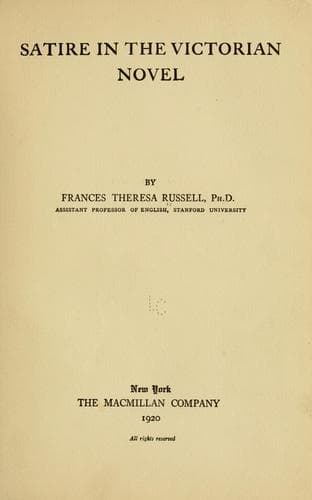
Satire in the Victorian novelRussell, Frances Theresa
History
Satire in the Victorian novel
Russell, Frances Theresa
English fiction -- 19th century -- History and criticism; Satire, English -- History and criticism; Thesis (Ph. D.)
“Mr. Curdle coughed and considered. ‘The unities, sir,’ he said,
‘are a completeness--a kind of universal dovetailedness with
regard to place and time--a sort of a general oneness, if I may
be allowed to use so strong an expression. I take those to be
the dramatic unities, so far as I have been enabled to bestow
attention upon them, and I have read much upon the subject and
thought much. I find, running through the performances of this
child,’ said Mr. Curdle, turning to the Phenomenon, ‘a unity of
feeling, a breadth, a light and shade, a warmth of colouring, a
tone, a harmony, a glow, an artistical development of original
conceptions, which I look for, in vain, among older performers.
I don’t know whether I make myself understood?’
“‘Perfectly,’ replied Nicholas.
“‘Just so,’ said Mr. Curdle, pulling up his neckcloth. ‘That is
my definition of the unities of the drama.’”
The great trio, Pecksniff, Bagstock, and Heep, occur in the three
successive novels of the six years ending with the mid-century.
Pecksniff is the most gratuitous offender, for he encases himself in
piety and benevolence, and inserts his falseness into every word,
every deed, every relation of life. Heep’s specious humility is as
unrelaxed and vigilant, but it is more of a means to an end and not,
like Pecksniff’s, an end in itself. He fawns and flatters and cheats
for the benefits to be derived from such policies. Thus slippery are
the steps of Uriah’s ladder. He has, moreover, a word of self-defense
which forces his educational training to share the responsibility.
When he is reminded by Copperfield that greed and cunning always
overreach themselves, he retorts by implicating the school where he was
taught “from nine o’clock to eleven, that labour was a curse; and from
eleven o’clock to one, that it was a blessing and a cheerfulness and a
dignity,” and so on. Major Bagstock resembles Heep in being servile in
manner instead of pompously patronizing; but while Chesterton may be
right in calling him a more subtle hypocrite than Pecksniff,[357] it is
also true that the Major’s hypocrisy is not quite his whole existence,
as it is of both Pecksniff and Heep. He is at least a gourmand in
addition, if nothing more.
Before Dickens, in our period, the only character to exemplify this
trait, aside from Peacock’s Feathernest, is Lytton’s Robert Beaufort,
in _Night and Morning_. The author remarks in a later preface that
this character might be rated as a forerunner to Pecksniff; but he is
in reality more of the Blifil type, his brother Philip acting as his
Tom Jones.
Lytton, however, is inclined to discuss the subject by the way. In one
of his earlier novels he says,--[358]
“Honesty--patriotism--religion--these have had their hypocrites
for life;--but passion permits only momentary dissemblers.”
In a later one he analyzes a dubious citizen:[359]
Public-domain text, read in full here on John Shaqi.
Reviews
Reviews
No reviews yet
Be the first to share your thoughts on this work.
Elsewhere in the archive
Join the Discussion
Join the discussion
Sign in to leave a comment or review.
Sign InorCreate an account