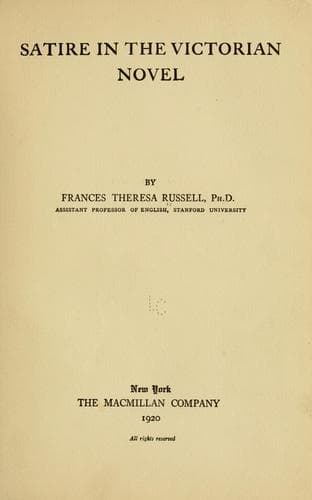
Satire in the Victorian novelRussell, Frances Theresa
History
Satire in the Victorian novel
Russell, Frances Theresa
English fiction -- 19th century -- History and criticism; Satire, English -- History and criticism; Thesis (Ph. D.)
“But our banker was really a charitable man, and a benevolent
man, and a sincere believer. How, then, was he a hypocrite?
Simply because he professed to be far _more_ charitable, _more_
benevolent, and _more_ pious than he really was. His reputation
had now arrived to that degree of immaculate polish that the
smallest breath, which would not have tarnished the character of
another man, would have fixed an indelible stain upon his.”
The same might be said of another banker, the respectable
Bulstrode, whom George Eliot presents with no satire and an almost
pitiful sympathy.
The wealthy plebeian Avenel is embarrassed by the inopportune arrival
of his rustic sister in the presence of his aristocratic guests. By
a brilliant counter-stroke of a candid and courageous confession, he
stems the tide and wins the day. But in private he is very severe with
the poor culprit, and then admits to himself, “I’m a cursed humbug, * *
* but the world _is_ such a humbug!”[360]
The only Pecksniffian hypocrite outside of Dickens is the Reverend
Brocklehurst, whom Jane Eyre describes as lecturing to the half starved
and shivering girls at the school of which he was trustee, on the
beauty of asceticism and the holiness of economy, while his wife and
daughters sit in state on the platform, curled, bejewelled, opulent in
plumes and velvet.
The cant and manœuvering of the Thackeray and Trollope hypocrites are
necessary as first aid to the ambitious. By means of them Becky Sharp
achieves a husband, Mrs. Mackenzie a son-in-law, Moffit and Crosbie
a patrician father-in-law, and Lady Carbury a literary reputation.
Mr. Slope and the Pateroffs fail but no less bear up beneath their
unsuccess. Melmotte, another Merdle, succumbs, like him, forced to
realize that deceit may strike one with a tragic rebound.
Jermyn and Grandcourt, the latter especially, indulge in deceit out of
pure selfishness, but in neither of them does George Eliot consider
hypocrisy a matter for even satirical mirth. In lighter vein she does
indeed show up the _poseur_ in low life. Mr. Dowlas, oracle of _The
Rainbow_, laying down the law about ghosts, is too frightened by the
apparition of Silas Marner to speak. Having recovered and feeling “that
he had not been quite on a par with himself and the occasion,” he
intrigues to get appointed as deputy constable, and consents to serve,
after “duly rehearsing a small ceremony known in high ecclesiastical
life as _nolo episcopari_.” Mr. Scales, discoursing largely on
excommunication, is another caught in the Socratic trap by being asked
for definition of the term. He is no less ready than Mr. Curdle, though
more sententious:[361]
“Well, it’s a law term--speaking in a figurative sort of
way--meaning that a Radical was no gentleman.”
It is George Eliot who sees the necessity of the mask that most are
content simply to tear away or disfigure. Although she speaks through a
worldly wise character, she sounds no note of dissent:[362]
Public-domain text, read in full here on John Shaqi.
Reviews
Reviews
No reviews yet
Be the first to share your thoughts on this work.
Elsewhere in the archive
Join the Discussion
Join the discussion
Sign in to leave a comment or review.
Sign InorCreate an account