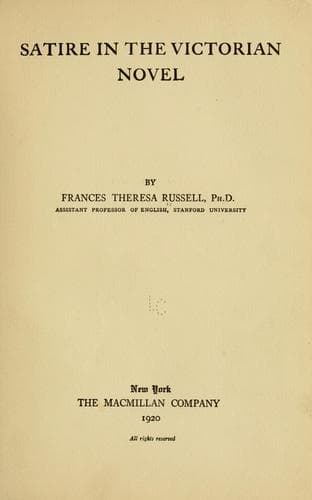
Satire in the Victorian novelRussell, Frances Theresa
History
Satire in the Victorian novel
Russell, Frances Theresa
English fiction -- 19th century -- History and criticism; Satire, English -- History and criticism; Thesis (Ph. D.)
“‘I’ll tell you what, Dan,’ said Sir Hugo, ‘a man who sets his
face against every sort of humbug is simply a three-cornered
impracticable fellow. There’s a bad style of humbug, but there
is also a good style--one that oils the wheels and makes
progress possible.’”
This is recognized also by Lytton, who quotes “an anonymous writer of
1722:”[363]
“Deceit is the strong but subtile chain which runs through all
the members of a society, and links them together; trick or be
tricked, is the alternative; ’tis the way of the world, and
without it intercourse would drop.”
Trollope subscribes with qualification, by having the archdeacon say,
on the death of Mrs. Proudie,--[364]
“The proverb of _De Mortuis_ is founded on humbug. Humbug
out of doors is necessary.”
At the extreme opposite from the hypocrites, shrewd, knowing, wise at
least in their own conceit, stand the incompetent, victims of folly;
satirized not for ignorance but for bland unconsciousness of it,
usually accompanied by a hallucination of efficiency. As the hypocrites
shade off into villains, to be rebuked without humor, such as Jasper
Losely, Randal Leslie, Bill Sykes, Sedgett, so the fools merge into the
artless, to be smiled at without rebuke, as Colonel Digby and Colonel
Newcome, Frank Hazeldean, the Vardens, Tom Pinch, Captain Cuttle,
and “poor, excommunicated Miss Tox, who, if she were a fawner and a
toad-eater, was at least an honest and a constant one.”
It is Dickens again who contributes the most data to this study, and
particularly to the genus, Silly Dame. Here his amusement over mere
fatuous complacency becomes warmed into scorn when that stupidity
affects the home she has in charge, and lowers into a failure the
very thing that it is most important to raise into success,--such
success not being automatic. Mrs. Nickleby, Mrs. Wilfer, Mrs. Finching,
like Jane Austen’s Mrs. Bennet and Mrs. Palmer, and Susan Ferrier’s
Lady Juliana Douglass, are comparatively harmless, and are indulged
accordingly. But an incapacity that may be picturesque in easy
circumstances deepens into a grave misdemeanor when joined to a small
income. Mrs. Micawber, Mrs. Pocket, Mrs. Pardiggle, and especially Mrs.
Jellyby are domestic pests, at whom we are more exasperated than amused.
Public-domain text, read in full here on John Shaqi.
Reviews
Reviews
No reviews yet
Be the first to share your thoughts on this work.
Elsewhere in the archive
Join the Discussion
Join the discussion
Sign in to leave a comment or review.
Sign InorCreate an account