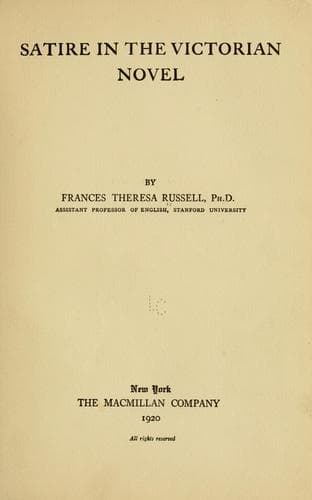
Satire in the Victorian novelRussell, Frances Theresa
History
Satire in the Victorian novel
Russell, Frances Theresa
English fiction -- 19th century -- History and criticism; Satire, English -- History and criticism; Thesis (Ph. D.)
Aside from Dickens, the only artist much interested in this stratum
of human nature is the one who has given us Mrs. Tulliver and Mrs.
Vincy and her daughter, but they are not real sources of trouble,
except Rosamund, and her failure is more spiritual than material. Mrs.
Tulliver, a plaintive, hopelessly literal soul, is distressed over her
husband’s metaphoric speech about “a good wagoner with a mole on his
face.” She resents feebly the dogmatizing of the majestic Mrs. Glegg,
but would never go “to the length of quarreling with her any more than
a water-fowl that puts out its leg in a deprecating manner can be said
to quarrel with a boy who throws stones.” Under another metaphor she
is an amiable fish, which, “after running her head against the same
resisting medium for thirteen years, would go at it again today with
undiluted alacrity.”[365]
Out of her saddening experience Rosamund did emerge somewhat wiser, but
with none of the higher wisdom which constitutes character.
“She simply continued to be mild in her temper, inflexible in
her judgment, disposed to admonish her husband, and also to
frustrate him by stratagem.”[366]
The other section of this class most fully recruited is made up of the
foolish young men. It might look as though in the novelist’s world
masculine folly were a malady incident to youth, while on the other
hand, the feminine sort appeared late. For it happens that Lydia and
Kitty Bennet have no real successors. There are indeed plenty of Hetty
Sorrels, Lucy Deanes, Rosa Mackenzies, Amelia Sedleys, Dahlia Flemings;
but their innocence and pathos protect them from satire. And the merely
vapid and vain school girl is apparently too worthless a figure to be
given a place on Victorian pages. So also seems the man whose mental
growth has not kept pace with the years. Mr. Micawber may be taken
as the exception that proves the rule. Sir Lukin Dunstane likewise
shows that one may reach man’s estate and flourish therein on a small
allotment of intelligence. He makes his best record in a gossipy
little conversation with his wife, to whom he is giving an account of
the Dacier-Asper wedding. Emmy had commented on the eloquence of his
report:[367]
“He murmured something in praise of the institution of
marriage--when celebrated impressively, it seemed.
“‘Tony calls the social world the “theater of appetites,” as we
have it at present,’ she said; ‘and the world at a wedding is,
one may reckon, in the second act in the hungry tragi-comedy.’
“‘Yes, there’s the breakfast,’ Sir Lukin assented. Mrs.
Fryar-Gunnett was much more intelligible to him; in fact, quite
so, as to her speech.”
Public-domain text, read in full here on John Shaqi.
Reviews
Reviews
No reviews yet
Be the first to share your thoughts on this work.
Elsewhere in the archive
Join the Discussion
Join the discussion
Sign in to leave a comment or review.
Sign InorCreate an account