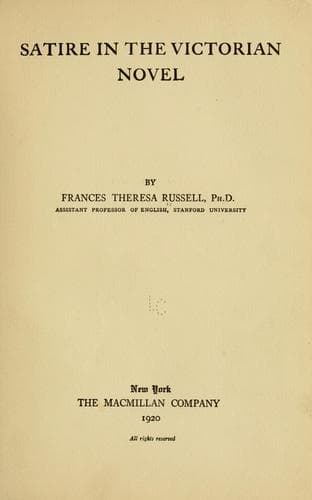
Satire in the Victorian novelRussell, Frances Theresa
History
Satire in the Victorian novel
Russell, Frances Theresa
English fiction -- 19th century -- History and criticism; Satire, English -- History and criticism; Thesis (Ph. D.)
Folly is more ludicrous in the young man than in the maid, on account
of his greater conspicuousness in affairs, and the greater things
expected of him,--any failure divulging the discrepancy between fact
and fancy which is the basis of humor. It is also true that he stands
a better chance of having his foolishness shaken out of him in his more
exposed and strenuous life. Both these conditions are implied in a
reflection made by one of Trollope’s characters. Isabel Boncassen, the
frank American beauty, looks upon the young man as a type:[368]
“Young men are pretty much the same everywhere, I guess. They
never have their wits about them. They never mean what they
say, because they don’t understand the use of words. They are
generally half impudent and half timid. When in love they do not
at all understand what has befallen them. What they want they
try to compass as a cow does when it stands stretching out its
head toward a stack of hay which it cannot reach. Indeed, there
is no such thing as a young man, for a man is not really a man
till he is middle-aged. But take them at their worst, they are a
deal too good for us, for they become men some day, whereas we
must only be women to the end.”
Dickens is again a contributor of portraits, though not of the best,
and is joined this time by Thackeray, Trollope, and Meredith.
Tom Gradgrind, product of a system, and Edmund Sparkler, product of a
lack of system, deserve mention, as does Edward Dorrit, though sketched
without color. Rawdon Crawley and Joseph Sedley, no longer in first
flush of youth, are consistent exponents of gullible good nature and
ponderous vacuity. But the two prizes of undeviating stupidity are Sir
Felix Carbury and Algernon Blancove.
Sir Felix is a spoiled darling and an excrescence on the face of the
earth. His accomplishments are set forth in a description of his
state of enforced solitude consequent upon his latest exhibition of
monumental inefficiency:[369]
“He had so spent his life hitherto that he did not know how
to get through a day in which no excitement was provided for
him. He never read. Thinking was altogether beyond him. And he
had never done a day’s work in his life. He could lie in bed.
He could eat and drink. He could smoke and sit idle. He could
play cards; and could amuse himself with women,--the lower the
culture of the women, the better the amusement. Beyond these
things the world had nothing for him.”
Public-domain text, read in full here on John Shaqi.
Reviews
Reviews
No reviews yet
Be the first to share your thoughts on this work.
Elsewhere in the archive
Join the Discussion
Join the discussion
Sign in to leave a comment or review.
Sign InorCreate an account