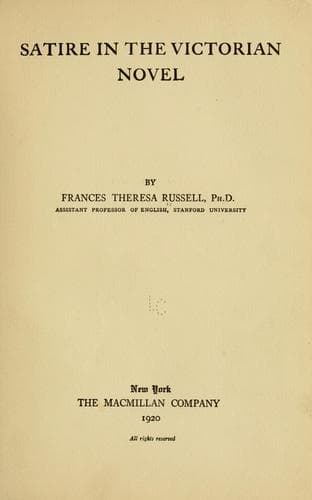
Satire in the Victorian novelRussell, Frances Theresa
History
Satire in the Victorian novel
Russell, Frances Theresa
English fiction -- 19th century -- History and criticism; Satire, English -- History and criticism; Thesis (Ph. D.)
“‘I must forget myself. I’m under some doom. I see it now.
Nobody cares for me. I don’t know what happiness is. I was born
under a bad star. My fate’s written.’ Following his youthful
wisdom, this wounded hart dragged his slow limbs toward the
halls of brandy and song.
“One learns to have compassion for fools, by studying them: and
the fool, though Nature is wise, is next door to Nature. He is
naked in his simplicity; he can tell us much, and suggest more.
My excuse for dwelling upon him is, that he holds the link of my
story. Where fools are numerous, one of them must be prominent
now and then in a veracious narration.”
According to the old duality of satirized objects,--Vice and Folly,
identified with the deceiver and the deceived,--the two classes just
discussed would exhaust the list. But these signify folly in its
narrowest and most literal sense, a plain lack of brains and a general
incapacity. In its wider sense it includes misuse as well as want of
intelligence. These mortals, as Puck discovered, are indeed all fools,
at times and on certain points. The number may not be infinite, but
Lydgate discovered sixty-three kinds; and Barclay augmented the list to
nearly one hundred. Perfect wisdom would cast out not only ignorance,
but also frivolity, sentimentality, vanity, all sorts of false
standards and all manner of fallacies. Therefore snobs, romanticists,
egoists, fanatics, merely exemplify folly in its varieties and
ramifications.
The snob is defined by his great expositor as “one who meanly
admires mean things.” A modern scholar calls vulgarity “satisfaction
with anything inferior when a superior is attainable.”[375] These
definitions together indicate why snobbishness and vulgarity are
allied, though not identical. There is, however, this difference,
that satisfaction implies in itself a passive acquiescence,
whereas admiration leads naturally to imitation, and if possible,
appropriation, of the thing approved. Of course, satisfaction on a
different plane results from a feeling of attainment and possession;
but it then becomes pride or vanity, which in turn may or may not be of
the snobbish sort.
In popular apprehension, indeed, snobbishness and vulgarity are
rated as more opposite than allied. The snob is thought of as either
belonging to the polite world or trying to secure an entrance to its
polished circles. If he occupies the former position, he boasts of his
refinement, and from his eminence contemplates with scorn or at best an
affable condescension, the mob below. To this class belong such members
as Lytton’s and Disraeli’s aristocrats; such diverse types in Dickens
as Sir John Chester, the Monseigneur in _Tale of Two Cities_,
Mrs. General, and Mrs. Gowan; Thackeray’s Marquis of Steyne, Major
Pendennis, and the Misses Pinkerton; Trollope’s de Courcys and the
Chaldicote circle; Meredith’s Everard Romfrey and Ferdinand Laxley.
Public-domain text, read in full here on John Shaqi.
Reviews
Reviews
No reviews yet
Be the first to share your thoughts on this work.
Elsewhere in the archive
Join the Discussion
Join the discussion
Sign in to leave a comment or review.
Sign InorCreate an account