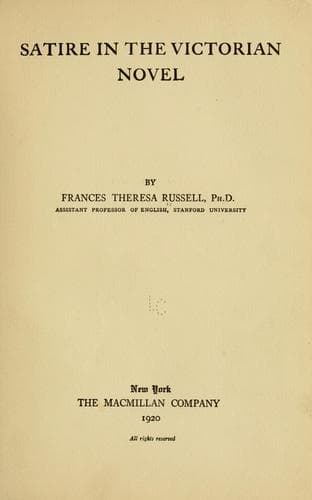
Satire in the Victorian novelRussell, Frances Theresa
History
Satire in the Victorian novel
Russell, Frances Theresa
English fiction -- 19th century -- History and criticism; Satire, English -- History and criticism; Thesis (Ph. D.)
But if the snob is engaged in climbing up instead of looking down, he
is likely to have some common clay still clinging to his shoes, as well
as to be dishevelled by the exertions of the ascent. Such insignia of
vulgarity are worn by a numerous clan, including the politician Rigby,
the money-lender Baron Levy;[376] the Veneerings and Dorrits, and those
patriotic American snobs whom Martin Chuzzlewit found so insufferably
vulgar; Barry Lyndon, Mr. Osborne, and Becky Sharp; Mr. Slope, Mr.
Crosbie, and the great Melmotte.
On the other hand, the frankly vulgar is reckoned among the plebeians.
As there is a snobbishness free from coarseness, so there is a
vulgarity unembellished even by pseudo-culture. In this ugly and gross
scum of the earth no novelist really delights except the creator of
Mrs. Gamp, Quilp, Squeers, and Fagin and his crew, though Thackeray is
able to depict Sir Pitt Crawley; Trollope, the Scathards; and Meredith,
Sedgett.
The compound of snobbishness and vulgarity has the additional
complexity of ramifying into hypocrisy on one side and sentimentality
on the other. The first conjunction is made because of the incitement
to that fawning, flattering servility that more than anything else
rouses satiric disgust. The second occurs when the flattering unction
is laid to one’s own soul instead of being paid to the possessions of
others. The first is obvious and its examples are legion. The second
is more subtle and obscure, though perhaps almost as prevalent. It
consists in an inaccurate orientation, a supposition that one has
arrived at a goal, when the case is otherwise. Such unwarranted
complacency cheers the lot of Mrs. Kirkpatrick, Mrs. Hobson Newcome,
Mrs. Proudie, and the Countess de Saldar.
This, however, is only one phase of sentimentality. It also may
exist independently, or otherwise combined than with snobbishness
or vulgarity. It is a term somewhat ambiguous because of a recently
changed connotation.
In the eighteenth century it was “sensibility,” and regarded as a
virtue until Jane Austen exhibited it in Marianne Dashwood and
her mother. At that time it was thought of as excess of feeling or
sentiment cherished for its own sake, without much regard for the
worthiness of its object. Marianne, disappointed in the vanished
romance she had built up chiefly from imaginative material, “would have
thought herself very inexcusable had she been able to sleep at all the
first night after parting from Willoughby. She would have been ashamed
to look her family in the face the next morning, had she not risen from
her bed in more need of repose than when she lay down in it.”[377]
Public-domain text, read in full here on John Shaqi.
Reviews
Reviews
No reviews yet
Be the first to share your thoughts on this work.
Elsewhere in the archive
Join the Discussion
Join the discussion
Sign in to leave a comment or review.
Sign InorCreate an account