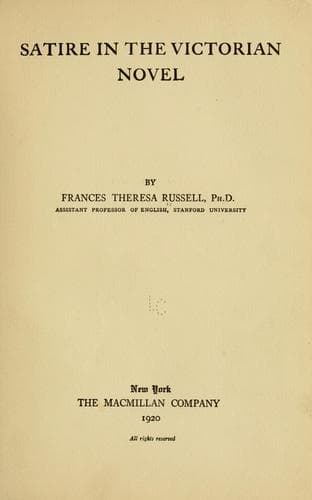
Satire in the Victorian novelRussell, Frances Theresa
History
Satire in the Victorian novel
Russell, Frances Theresa
English fiction -- 19th century -- History and criticism; Satire, English -- History and criticism; Thesis (Ph. D.)
If Meredith, three-quarters of a century later, had been relating the
sad fortunes of a self-deceived young lady, he would have stressed
in his account of her character, the cause of the trouble, that is,
the process of constructing a Spanish castle with a flimsy foundation
in fact, rather than the effect, namely, the emotional orgy which
celebrated its inevitable but astonishing collapse. He would have
seen that preliminary process as possible because of the disregard
for facts which is the real mark of the sentimentalist.[378] This
later interpretation is not a contradiction of the earlier one, but
a shifting of emphasis. The common factor in the two definitions is
feeling, ranging all the way from simple preference or inclination to
strong emotion. But whereas formerly this element was accepted without
further analysis, it came later to be accounted for in its relation
to the intellect. Emotion is an excellent driver but an untrustworthy
leader. It is when it assumes leadership, when action is not only
impelled but guided by feeling, that the ensuing motion is in danger
of being erratic, unprogressive, perhaps calamitous. This more or less
wilful blindness, which is the essence of sentimentality, is of course
a very natural human trait. Since it is the function of emotion to
supply heat, and of intellect to furnish light, and since warmth is as
a rule more grateful than illumination, particularly if the prospect
does not please, we are much more likely to be warmed in our passage
through life than illumined. To refuse to see the disagreeable is as
instinctive as to seek the delightful. Nor could one be regarded as
more of a fault than the other until the love of truth for its own sake
became an ideal, accompanying the dominance of the scientific spirit.
This accounts for the fact that, while Meredith did not invent the
sentimentalist any more than Dickens the hypocrite or Thackeray
the snob, he is the first to take a deep and conscious interest in
this species; being especially fitted for it by his own incisive,
highly rationalized nature as well as by the spirit of his time. His
predecessors in this field are Peacock, Gaskell, Dickens, Thackeray,
and Eliot, although the last is rather a contemporary.
From Squire Headlong, the would-be savant, to Mr. Falconer, the
would-be Platonist and devotee of Saint Cecilia, Peacock traces a vein
of rather innocuous sentimentality, but of Miss Damaretta Pinmoney he
gives a definite account, followed by several examples:[379]
“She had cultivated a great deal of theoretical romance--in
taste, not in feeling--an important distinction--which enabled
her to be most liberally sentimental in words, without at all
influencing her actions.”
Public-domain text, read in full here on John Shaqi.
Reviews
Reviews
No reviews yet
Be the first to share your thoughts on this work.
Elsewhere in the archive
Join the Discussion
Join the discussion
Sign in to leave a comment or review.
Sign InorCreate an account