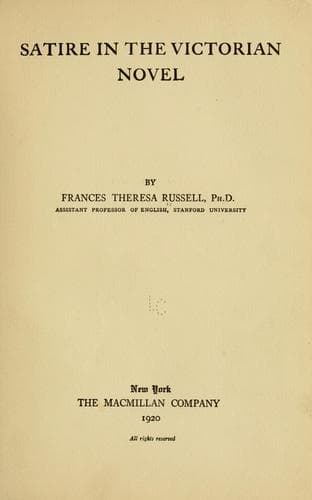
Satire in the Victorian novelRussell, Frances Theresa
History
Satire in the Victorian novel
Russell, Frances Theresa
English fiction -- 19th century -- History and criticism; Satire, English -- History and criticism; Thesis (Ph. D.)
Mrs. Shaw represents those who so appreciate the value of romantic
affliction that, lacking a grief, they manufacture a grievance to cover
the deficiencies of a too roseate existence. On a certain melancholy
occasion to be sure she orders “those extra delicacies of the season
which are always supposed to be efficacious against immoderate grief at
farewell dinners.” But her usual manner--[380]
“* * * had always something plaintive in it, arising from the
long habit of considering herself a victim to an uncongenial
marriage. Now that, the General being gone, she had every good
of life, with as few drawbacks as possible, she had been rather
perplexed to find an anxiety, if not a sorrow. She had, however,
of late settled upon her own health as a source of apprehension;
she had a nervous little cough whenever she thought about
it; and some complaisant doctor ordered her just what she
desired,--a winter in Italy.”
It is Mrs. Kirkpatrick, however, who takes the prize in “pink
sentimentalism,” and holds it until the arrival of the Countess de
Saldar, and the Pole sisters. Behind the “sweet perpetuity of her
smile” is carried on an equally perpetual manœvering, which ministers,
under the auspices of refinement and the proprieties, to a small and
selfish tyranny. If by any chance she is detected or foiled, she
is deeply wounded, for if she hates anything, “it is the slightest
concealment and reserve.” Moreover, she never thinks of herself,
and is “really the most forgiving person in the world, in forgiving
slights.” She is overcome by the spring weather,--[381]
“_Primavera_, I think the Italians call it. * * * It makes
me sigh perpetually; but then I am so sensitive. Dear Lady
Cumnor used to say I was like a thermometer.”
But it is in her association with Lady Harriet that her sincerity
and candor shine forth. Apprised, on one occasion, of the intention
of that personage--an aristocrat in character as well as social
station--to honor her with a morning call, she dispatches to a neighbor
her stepdaughter Molly, of whose friendship with Lady Harriet she is
jealous, and keeps at home her own daughter Cynthia, to prepare the
especially delicious luncheon to which the guest is to be invited as
an impromptu bit of pot-luck. During this visit Lady Harriet brings up
the question of white lies, confessing to an occasional indulgence,
and asking her hostess if she never yielded to the temptation. She is
answered:[382]
“I should have been miserable if I ever had. I should have died
of self-reproach. ‘The truth, the whole truth, and nothing but
the truth,’ has always seemed to me such a fine passage. But
then I have so much that is unbending in my nature.”
Public-domain text, read in full here on John Shaqi.
Reviews
Reviews
No reviews yet
Be the first to share your thoughts on this work.
Elsewhere in the archive
Join the Discussion
Join the discussion
Sign in to leave a comment or review.
Sign InorCreate an account