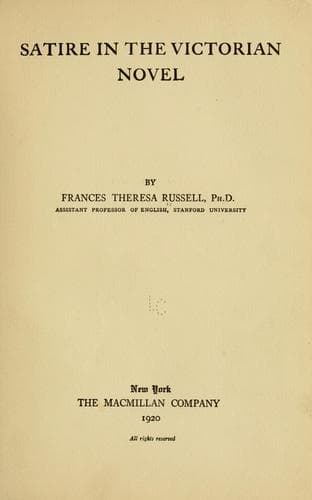
Satire in the Victorian novelRussell, Frances Theresa
History
Satire in the Victorian novel
Russell, Frances Theresa
English fiction -- 19th century -- History and criticism; Satire, English -- History and criticism; Thesis (Ph. D.)
Dickens and Thackeray, like Lytton, Reade, and Kingsley, have too much
of this trait in their own temperaments to be able to view it with
complete detachment, but they present a few samples. Besides Mrs.
Wititterly, Harold Skimpole, and the ever illustrative Mr. Dorrit,
Dickens is most successful with Mr. and Mrs. Micawber, and Mrs. Chick.
When Mr. Micawber, stimulated by the prospect of something being
about to turn up, presents poor Traddles, with great _éclat_ and
ceremony, his personal note for the exact amount of his indebtedness,
David, a witness, reflects:[383]
“I am persuaded, not only that this was quite the same to Mr.
Micawber as paying the money, but that Traddles himself hardly
knew the difference until he had had time to think about it.”
Mrs. Chick, with true Dombian genius, having helped to loosen her
sister-in-law’s slender hold upon life, now enjoys the pathos of the
situation:[384]
“What a satisfaction it was to Mrs. Chick--a commonplace piece
of folly enough, * * * to patronize and be tender to the memory
of that lady; in exact pursuance of her conduct to her in her
lifetime; and to thoroughly believe herself, and take herself
in, and make herself uncommonly comfortable on the strength of
her toleration! What a mighty pleasant virtue toleration should
be when we are right, to be so very pleasant when we are wrong,
and quite unable to demonstrate how we came to be invested with
the privilege of exercising it!”
In her capricious cruelty to Lucretia Tox, she pretends to be
scandalized at what she had fostered all along, and taunts the dismayed
woman for the very thing she had been aiding and abetting:[385]
“‘The scales;’ here Mrs. Chick cast down an imaginary pair,
such as are commonly used in grocers’ shops; ‘have fallen from
my sight.’ * * * ‘How can I speak to you like that?’ retorted
Mrs. Chick, who, in default of having any particular argument to
sustain herself upon, relied principally upon such repetitions
for her most withering effects. ‘Like that! You may well say
like that, indeed!’”
Public-domain text, read in full here on John Shaqi.
Reviews
Reviews
No reviews yet
Be the first to share your thoughts on this work.
Elsewhere in the archive
Join the Discussion
Join the discussion
Sign in to leave a comment or review.
Sign InorCreate an account