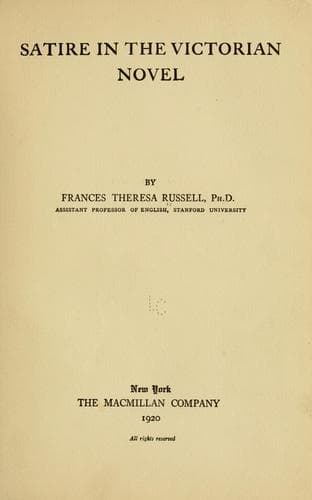
Satire in the Victorian novelRussell, Frances Theresa
History
Satire in the Victorian novel
Russell, Frances Theresa
English fiction -- 19th century -- History and criticism; Satire, English -- History and criticism; Thesis (Ph. D.)
Thackeray is included in this list chiefly on the strength of the
Osbornes, Pitt Crawley, and to a less degree, Blanche Armory and
Mrs. Bute. Of the first he says, regarding certain declarations of
disinterested friendliness and admiration,--“There is little doubt
that old Osborne believed all he said, and that the girls were quite
in earnest in their protestations of affection for Miss Swartz.” And
his thrust at the hoodwinked Pitt’s delighted apprehension that the
clever Becky really understood and appreciated him, is a palpable hit.
He also arraigns under this head his favorite satirical object,--“the
moral world, that has, perhaps, no particular objection to vice, but
an insuperable repugnance to hearing vice called by its proper name.”
On the other hand, more than any other novelist, he has given us
sentimentalists unaware; that is, in such characters as Helen, Laura,
and Arthur Pendennis, Lady Castlewood, and Colonel Newcome, he shares
their own unawareness of the possession of this foible, though in all
these it is of an innocent variety.
George Eliot is keenly alive to this blindness in human nature,
particularly as it manifests itself in the pernicious optimism of weak
and wilful youth; but as with other mortal failures, it is usually too
serious in her eyes for satire. Of all her novels, _Felix Holt_ and
_Daniel Deronda_ alone have no character of this type. In the others
he appears as Arthur Donnithorne, Stephen Guest, Godfrey Cass, Tito
Melema, and Fred Vincy; but rarely is he ridiculed, and then ironically.
Of the bonny young Squire Donnithorne she draws the portrait as he
himself would see it:[386]
“* * * candour was one of his favorite virtues; and how can a
man’s candour be seen in all its lustre unless he has a few
failings to talk of? But he had an agreeable confidence that his
faults were all of a generous kind--impetuous, warm-blooded,
leonine; never crawling, crafty, reptilian. ‘No! I’m a devil
of a fellow for getting myself into a hobble, but I always
take care the load shall fall on my own shoulders.’ Unhappily
there is no inherent poetic justice in hobbles, and they will
sometimes obstinately refuse to inflict their worst consequences
on the prime offender, in spite of his loudly-expressed wish. It
was entirely owing to this deficiency in the scheme of things
that Arthur had ever brought any one into trouble besides
himself.”
Even when troublesome consequences threatened both himself and others,
he was buoyed up by “a sort of implicit confidence in him that he was
really such a good fellow at bottom, Providence would not treat him
harshly.”
Tito Melema also leaned heavily on the law of compensation:[387]
“It was not difficult for him to smile pleadingly on those whom
he had injured, and offer to do them much kindness: and no
quickness of intellect could tell him exactly the taste of that
honey on the lips of the injured.”
Public-domain text, read in full here on John Shaqi.
Reviews
Reviews
No reviews yet
Be the first to share your thoughts on this work.
Elsewhere in the archive
Join the Discussion
Join the discussion
Sign in to leave a comment or review.
Sign InorCreate an account