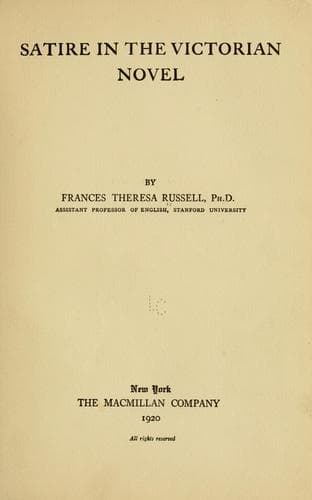
Satire in the Victorian novelRussell, Frances Theresa
History
Satire in the Victorian novel
Russell, Frances Theresa
English fiction -- 19th century -- History and criticism; Satire, English -- History and criticism; Thesis (Ph. D.)
Mrs. Proudie herself is above all a politician, and justifies her
existence by turning her religious bigotry into the channel of
ecclesiastical polity, a procedure that well might cause the gentle
bishop to quake:[400]
“When Mrs. Proudie began to talk about the souls of the people
he always shook in his shoes. She had an eloquent way of raising
her voice over the word souls that was qualified to make any
ordinary man shake in his shoes.”
She rejoices in an opportunity to condone with a member of the Clerical
Opposition over a disappointment she has done her best to bring upon
it:[401]
“‘For, after all, Mrs. Arabin, what are the things of this
world?--dust beneath our feet, ashes between our teeth, grass
cut for the oven, vanity, vexation, and nothing more!’--well
pleased with which variety of Christian metaphors, Mrs. Proudie
walked on, still muttering, however, something about worms and
grubs, by which she intended to signify her own species and the
Dumbello and Grantly sects of it in particular.”
George Eliot’s zealots,--Dinah Morris, Savonarola, Felix Holt, Daniel
Deronda, are not ridiculed, except for some sarcastic repartee put into
the mouths of Mrs. Poyser and Esther Lyon. Nor is the pseudo-scholar
Casaubon, though he is described as having a soul that “went on
fluttering in the swampy ground where it was hatched, thinking of its
wings and never flying,” and on a certain occasion, as slipping “again
into the library, to chew a cud of erudite mistake about Cush and
Mizraim.”
Of all fanatics, those who are obsessed by an educational theory are
perhaps the most dangerous, as they impose their systems on flexible
youth, the result being often an orchard of lamentably bent twigs. Two
exponents of opposite divisions of this type are Gradgrind, who aimed
at the elimination of the imagination, and Feverel, who proposed to
circumvent the element of original sin in human composition, by the
policy of watchful waiting and absolute dictation. Both come to grief
through the failure of facts to support their philosophies; but Dickens
in his optimism makes Gradgrind a wiser man through being a sadder,
while Meredith in his realism keeps Feverel blandly unconscious and
untaught by a lesson that would have pierced any heart protected by a
less impervious pericardium.
Public-domain text, read in full here on John Shaqi.
Reviews
Reviews
No reviews yet
Be the first to share your thoughts on this work.
Elsewhere in the archive
Join the Discussion
Join the discussion
Sign in to leave a comment or review.
Sign InorCreate an account