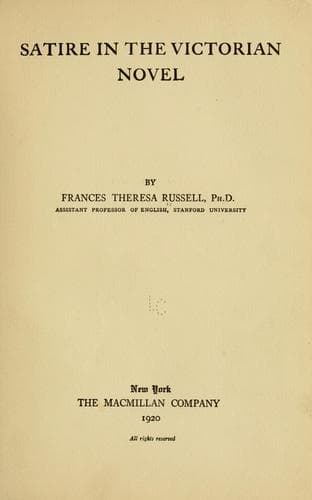
Satire in the Victorian novelRussell, Frances Theresa
History
Satire in the Victorian novel
Russell, Frances Theresa
English fiction -- 19th century -- History and criticism; Satire, English -- History and criticism; Thesis (Ph. D.)
All the materials that go into the warp and woof of human nature are
thus seen to be so commingled and interwoven that even the degree of
separation necessary for examination is almost impossible. And when
this dissection is after a fashion accomplished, it is the less useful,
in that the same strand is discovered to change its color and texture
from one section to another. Deception is here a vice and there a
virtue. Folly is here amusing and there horrifying. Egoism is here
absorbent and there encroaching. There are sentimental epicures and
unsentimental epicures and ascetic sentimentalists. There are vulgar
snobs and refined snobs and a vulgarity that is not snobbish. All of
these are criticizably absurd at times, and yet the same things may at
others be admirable or pathetic or tragic. Frequently the sublime and
the ridiculous advance on the one step that separates them, and merge
their diverse identities.
A peculiarly good illustration of the qualified nature of human
traits, in view of which we are wise to discard nouns in favor of
adjectives for identifying purposes, is furnished by Trollope’s Lady
Carbury. She is hypocritical in her wire-pulling intrigues, but not
a hypocrite, for her pretenses are not utterly hollow; her sincerity
is about on the average level, and her industry much above it. She is
sentimentally foolish in her maternal devotion to a son who has no
possible claim on toleration, much less on a patient and sacrificing
indulgence, but not a fool, for her cleverness is indisputable. She is
as tyrannic to her daughter as lenient to her son, but not a selfish
egoist, for she refuses to take advantage of Mr. Broune’s offer of
marriage, especially tempting to her harassed soul, on the altruistic
grounds that she and her family would be more of a burden than a
comfort to Mr. Broune. She is not a vulgar snob, but her respect for
aristocratic connections is not always marked by refinement of method
in her pursuit of them. Much of all this is unconsciously betrayed in
the series of three letters to editors and critics, bespeaking their
good offices for her new book, _Criminal Queens_. The epistles are
tactfully adjusted to their respective recipients. To Mr. Broune, of
_The Morning Breakfast Table_, she is intimately confiding and begs
frankly for a lift, while pointing out the attractive features of her
volume:[402]
Public-domain text, read in full here on John Shaqi.
Reviews
Reviews
No reviews yet
Be the first to share your thoughts on this work.
Elsewhere in the archive
Join the Discussion
Join the discussion
Sign in to leave a comment or review.
Sign InorCreate an account