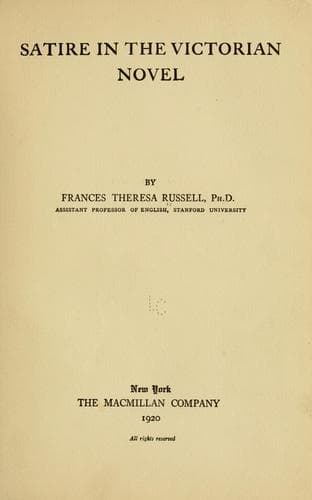
Satire in the Victorian novelRussell, Frances Theresa
History
Satire in the Victorian novel
Russell, Frances Theresa
English fiction -- 19th century -- History and criticism; Satire, English -- History and criticism; Thesis (Ph. D.)
“The sketch of Semiramis is at any rate spirited, though I had
to twist it about a little to bring her in guilty. Cleopatra,
of course, I have taken from Shakespeare: what a wench she was!
I could not quite make Julia a queen; but it was impossible
to pass over so piquant a character. * * * Marie Antoinette I
have not quite acquitted. It would be uninteresting,--perhaps
untrue. I have accused her lovingly, and have kissed when I have
scourged. I trust the British public will not be angry because
I do not whitewash Caroline, especially as I go along with them
altogether in abusing her husband.”
To Mr. Booker, of _The Literary Chronicle_, she is gently menacing,
reminding him that she has engaged to review his _New Tale of a Tub_
for _The Morning Breakfast Table_;[403]
“Indeed, I am about it now, and am taking great pains with it.
If there is anything you wish to have specially said as to your
view of the Protestantism of the time, let me know. I should
like you to say a word as to the accuracy of my historical
details, which I know you can safely do.”
To Mr. Alf, of _The Evening Pulpit_, of whom she has reason to be
afraid, her candor assumes a more impersonal and business-like air.
She alludes to a recent caustic criticism in the _Pulpit_ of some poor
poetic wretch who well deserved it:
“I have no patience with the pretensions of would-be poets who
contrive by toadying and underground influences to get their
volumes placed on every drawing-room table. * * * Is it not
singular how some men contrive to obtain the reputation of
popular authorship without adding a word to the literature of
their country worthy of note? It is accomplished by unflagging
assiduity in the system of puffing. To puff and to get one’s
self puffed have become different branches of a new profession.
Alas, me! I wish I might find a class open in which lessons
could be taken by such a poor tyro as myself.”
As for herself, she expects ruthless severity, but trusts that her work
has some merits. In any case, no amount of editorial flagellating can
discount her personal admiration for this particular editor. Truly, she
is all things to all men,--a policy, however, for which she might claim
a certain Scriptural precedent of high authority.
PART IV
CONCLUSIONS
CHAPTER I
RELATIONSHIPS
To call a man a satirist or a satirical writer is to say something
about him, certainly. It is, however, a piece of information which can
be nothing more than a curiosity of literature so long as it remains an
isolated fact. Although we are for the time being interested in a group
of novelists primarily as satirists, we cannot even understand them as
such, much less come to any fuller comprehension, unless we also view
the satirists as novelists, as artists, as human beings.
Public-domain text, read in full here on John Shaqi.
Reviews
Reviews
No reviews yet
Be the first to share your thoughts on this work.
Elsewhere in the archive
Join the Discussion
Join the discussion
Sign in to leave a comment or review.
Sign InorCreate an account