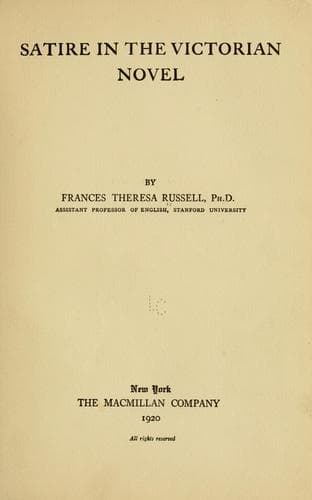
Satire in the Victorian novelRussell, Frances Theresa
History
Satire in the Victorian novel
Russell, Frances Theresa
English fiction -- 19th century -- History and criticism; Satire, English -- History and criticism; Thesis (Ph. D.)
These relationships extend on the internal side, so to speak, into such
matters as quantity, quality, and range; and on the external, into the
larger realms of the two satiric factors--criticism and humor--and
thence into the neighboring domains of pessimism and tragedy, comedy
and wit, realism and romanticism, emotion and intellect, and idealism.
In none of these things, of course, can we do more than indicate
briefly the effect they may have upon satire, or satire upon them.
Those who have furnished the largest amount of
satire,--proportionately, as it happens, both to their own total
production, and to the satiric production of others,--are Peacock,
Dickens, Butler, and Meredith. But when it comes to quality,--tested by
subtlety of wit, self-command, justice as to objects, and moderation of
amount,--the only one to remain on the preëminent list is Meredith.
At the other extreme we find the same overlapping as to quantity
and quality. The smallest satiric amounts come from Brontë, Reade,
and Gaskell, but, while the first two are correspondingly inferior
in quality, the last is promoted several degrees up the qualitative
scale, by reason of her lack of flourish, and the deft sureness of her
touch. The low place she leaves vacant belongs by desert to Kingsley,
who, like Brontë and Reade, never learned to solve the satirist’s
problem,--to trifle without being trivial. Frivolity, to be sure, was
never a besetting sin of the Victorians, but in their earnestness they
were prone to the opposite fault, and are occasionally caught beating a
big satiric drum when softer notes would be more effective. Neither are
any on the entire list guilty of downright insincerity, but the less
successful ones are sometimes betrayed by partisan zeal, acrimonious
temper, or unsound judgment, into more or less injustice. This is true
to some extent of Peacock, Dickens, and Thackeray, as well as of those
just mentioned.
In range of interest Dickens easily leads, followed by Meredith and
Trollope. From _Oliver Twist_ to _Edwin Drood_, this satirist spreads
his attacks over more ground, and lays about him in more different
directions than does any one else. With the exception of the Church,
no possible word of importance is omitted from his satiric lexicon.
His tastes in the ridiculous are catholic, and scarcely a satirizible
subject languishes under his neglect. The other writers are more or
less specialists in their chosen fields.
Public-domain text, read in full here on John Shaqi.
Reviews
Reviews
No reviews yet
Be the first to share your thoughts on this work.
Elsewhere in the archive
Join the Discussion
Join the discussion
Sign in to leave a comment or review.
Sign InorCreate an account