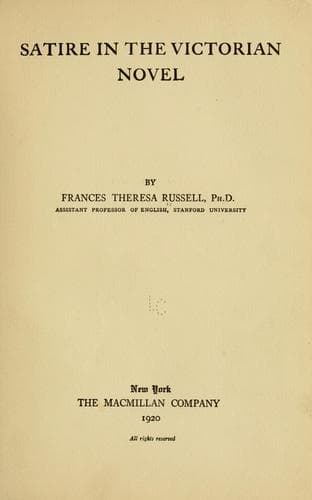
Satire in the Victorian novelRussell, Frances Theresa
History
Satire in the Victorian novel
Russell, Frances Theresa
English fiction -- 19th century -- History and criticism; Satire, English -- History and criticism; Thesis (Ph. D.)
As to the effect on the satiric product of a versatile mind, a prolific
pen, or preoccupation with other affairs, no deduction seems possible.
Lytton, Kingsley, and Butler were versatile and prolific both, to a
degree. Thackeray and Trollope were prolific within a more limited
range. Those most exclusively novelists were Disraeli, Dickens, and
Brontë, but those to produce the most novels were Trollope, Lytton,
Dickens, and Meredith. Lytton and Disraeli had more outside interests
and underwent more varieties of social and political experience than
any of their successors, though Trollope and Kingsley had occupations
and avocations outside those of literature.
All these internal relationships have some significance but much less
than the external ones. They deal primarily with accomplishments,
which have their value chiefly as emanating from character and so
defining it, whereas the various elements of which character itself is
composed are in the nature of vital statistics in the life spiritual.
Of these elements those most closely related to satire are naturally
its constituents, though they may exist independently of it. Although
satire is a form of criticism, it does not follow that those writers
who are most consistently satirical have the most widely or deeply
critical attitude toward life in general. Such fundamental criticism
branches out into two philosophies: the hopeless, or pessimistic,
shading off into flippant cynicism or bitter misanthropy; and the
hopeful, or unsentimentally optimistic, which is the basis of all
dynamic idealism. For whithersoever the idealist may tend, he certainly
cannot start from a point of uncritical satisfaction with things
as they are. Locke may have made some errors regarding the human
understanding, but he was eminently correct in identifying the stimulus
to action, not with a vision of fulfilled desire, but with the sting
that bids nor sit nor stand but go. We must be driven out before we
can be led on, but the driving process once being inaugurated, we make
it more dignified and endurable by conceiving a goal upon which our
endeavors may be focussed.
To the philosophy of pessimism no Victorian novelist was addicted.
The phase of it current in the period just preceding was met by a
prolonged, skeptical, British chuckle, beginning with our first
novelist, who represents, indeed, in his own history the reaction from
pensive melancholy to humorous common sense. Peacock is speaking of
being unhappy, and adds:[404]
“To have a reason for being so would be exceedingly commonplace:
to be so without any is the province of genius: the art of
being miserable for misery’s sake, has been brought to great
perfection in our days; and the ancient Odyssey, which held
forth a shining example of the endurance of real misfortune,
will give place to a modern one, setting out a more instructive
picture of querulous impatience under imaginary evils.”
Public-domain text, read in full here on John Shaqi.
Reviews
Reviews
No reviews yet
Be the first to share your thoughts on this work.
Elsewhere in the archive
Join the Discussion
Join the discussion
Sign in to leave a comment or review.
Sign InorCreate an account