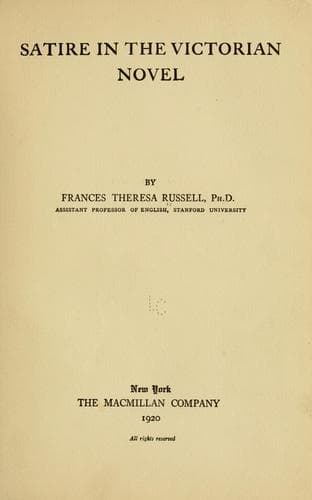
Satire in the Victorian novelRussell, Frances Theresa
History
Satire in the Victorian novel
Russell, Frances Theresa
English fiction -- 19th century -- History and criticism; Satire, English -- History and criticism; Thesis (Ph. D.)
“Yet what can satire, whether grave or gay?
It may correct a foible, may chastise
The freaks of fashion, regulate the dress,
Retrench a sword-blade, or displace a patch;
But where are its sublimer trophies found?
What vice has it subdu’d? whose heart reclaim’d
By rigour, or whom laugh’d into reform?
Alas! Leviathan is not so tam’d;
Laugh’d at, he laughs again; and, stricken hard,
Turns to the strike his adamantine scales,
That fear no discipline of human hands.”
Young[27] grants it a fighting chance:
“But it is possible that satire may not do much good; men may
rise in their affections to their follies, as they do to their
friends, when they are abused by others. It is much to be feared
that misconduct will never be chased out of the world by satire;
all, therefore, that is to be said for it is, that misconduct
will _certainly_ never be chased out of the world by
satire, if no satires are written. Nor is that term unapplicable
to graver compositions. Ethics, Heathen and Christian, and the
scriptures themselves, are, in a great measure, a satire on the
weakness and iniquity of men; and some part of that satire is in
verse, too. * * * Nay, historians themselves may be considered
as satirists and satirists most severe; since such are most
human actions, that to relate is to expose them.”
The distrust of the moderns is adequately voiced by Sidgwick:[28]
“Satire is the weapon of the man at odds with the world and at
ease with himself. The dissatisfied man--a Juvenal, a Swift,
a youthful Thackeray--belabors the world with vociferous
indignation, like the wind on the traveller’s back, the beating
makes it hug its cloaking sins the tighter. Wrong runs no danger
from such chastisement. * * * Satire is harmless as a moral
weapon. It is an old-fashioned fowling piece, fit for a man of
wit, intelligence, and a certain limited imagination. It runs no
risk of having no quarry; the world to it is one vast covert of
lawful game. It goes a-travelling with wit, because both are in
search of the unworthy.”
Two comments on Aristophanes illustrate the _pro_ and _con_
of satiric accomplishment. Cope, in the Preface to his translation,
remarks:
“He felt it his duty to do all he could to counteract the
increasing influence of Euripides upon the rising generation,
and knowing the power of ridicule, he employs this weapon
constantly and mercilessly; but he is careful not to injure his
own cause by exaggerated caricature, which might have created
sympathy for the object of his censure.”
But White, while warning us against regarding the dramatist as either
“a mere moralist or a mere jester,” judges by record:[29]
Public-domain text, read in full here on John Shaqi.
Reviews
Reviews
No reviews yet
Be the first to share your thoughts on this work.
Join the Discussion
Join the discussion
Sign in to leave a comment or review.
Sign InorCreate an account