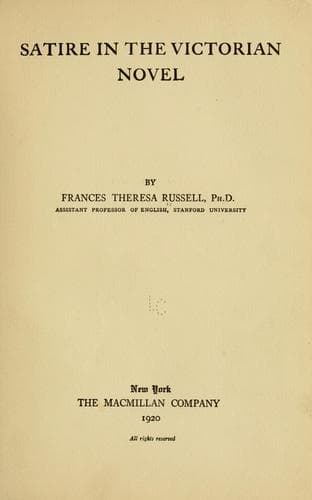
Satire in the Victorian novelRussell, Frances Theresa
History
Satire in the Victorian novel
Russell, Frances Theresa
English fiction -- 19th century -- History and criticism; Satire, English -- History and criticism; Thesis (Ph. D.)
Here we have in juxtaposition, quite unconsciously no doubt, his
_obiter dicta_ on emotion and intellect. In many places he had already
dramatized them. His egoists--Sir Austin, Sir Willoughby, Wilfred
Pole[419]--are satirized because they conceived love as self-assertion
instead of renunciation; his epicures and snobs--Adrian Harley, Edward
Blancove, Ferdinand Laxley--because their passion was neither noble
nor truly strong; his sentimentalists of every description, because
they neither realized that Truth is the highest thing a man may keep,
nor, whether high or not, would they purchase it at the price of a
disturbance to their equanimity. They might pray for the truth to be
pleasant, but never for fortitude to endure it if it were otherwise.
The apparent pessimism underlying the implication that the Truth is
such as to demand courage for facing it, is counterbalanced by Diana’s
exclamation, “Who can really _think_, and not think hopefully?”
None of Meredith’s novels lacks an intellectual theme, and it was this
that he himself regarded as most important. In the very last one he
says:[420]
“But the melancholy, the pathos of it, * * * have been
sacrificed in the vain effort to render events as consequent to
your understanding as a piece of logic, through an exposure of
character!”
At the same time he surpasses all others in the treatment of love.
Contemporary readers, who had had to be content with David and Dora,
Pen and Laura, Rochester and Jane, Adam and Dinah, were vouchsafed
a revelation,--which, however, they apparently did not at once
appreciate,--in Richard and Lucy, Evan and Rose, Redworth and Diana,
Dartrey and Nesta. To them all Meredith would say approvingly what he
said warningly to a more unfortunate cavalier,--“You may love, and
warmly love, so long as you are honest. Do not offend reason.”[421] And
in them all he illustrates the higher hedonism voiced by Lady Dunstane
to her Tony, though from the negative side,--“The mistake of the world
is to think happiness possible to the senses.”[422]
In addition to these, Meredith gives us pictures of other than the
purely romantic devotion. There is the brooding tenderness of maturity
for childhood and youth: of Sir Austin, Lady Blandish, Wentworth,
and Mrs. Berry, for Richard and later, Lucy; of Clara Middleton for
Crossjay; of Rosamund for Beauchamp. This relationship is enhanced by
a more intimate comradeship in the case of Lady Jocelyn and Rose, of
Natalia Radnor and Nesta, and, in a happy-go-lucky fashion, of Roy
Richmond and Harry. Nesta and Rose illustrate respectively Meredith’s
genuine and exquisite sentiment, and the omnipresent common sense which
preserved it from sentimentality. When Nesta felt the first chill of
the shadow on her life,--[423]
Public-domain text, read in full here on John Shaqi.
Reviews
Reviews
No reviews yet
Be the first to share your thoughts on this work.
Elsewhere in the archive
Join the Discussion
Join the discussion
Sign in to leave a comment or review.
Sign InorCreate an account