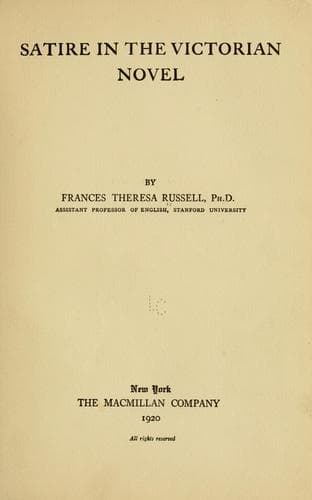
Satire in the Victorian novelRussell, Frances Theresa
History
Satire in the Victorian novel
Russell, Frances Theresa
English fiction -- 19th century -- History and criticism; Satire, English -- History and criticism; Thesis (Ph. D.)
“She sent forth her flights of stories in elucidation of the
hidden; and they were like white bird after bird winging to
covert beneath a thundercloud; until her breast ached for the
voice of the thunder: harsh facts: sure as she was of never
losing her filial hold of the beloved.”
When Rose determined to appeal their case to her mother, she said to
Evan,--[424]
“You know she is called a philosopher; nobody knows how
deep-hearted she is, though. My mother is true as steel. * *
* When I say kindness, I don’t mean any ‘Oh, my child,’ and
tears and kisses and maundering, you know. You mustn’t mind her
thinking me a little fool.”
Then there is the sisterly attachment between Rhoda and Dahlia Fleming
that leads Rhoda’s puritanic nature into a dictatorial fanaticism
as disastrous in its results as Sir Austin’s; there is friendship
masculine between Beauchamp and Dr. Shrapnel; and friendship feminine
between Lady Dunstane and Diana. It is not that Meredith has a monopoly
on the portrayal of human affection. Lytton has to his credit the
Chillinglys[425] and the Caxtons; Gaskell has the Gibsons; Dickens,
Amy Dorrit, and Joe Gargary; Brontë, Caroline Helstone and her mother;
Trollope, Lily Dale and hers; in Barry Lyndon, Thackeray gives us a
base soul redeemed by love for a child, and in Colonel Newcome, Helen
Pendennis, and Amelia Osborne, he presents a rather one-sided devotion,
as does Eliot in Mrs. Transome,--though the latter does not feel called
upon to exclaim, “By Heaven, it is pitiful, the bootless love of women
for children in Vanity Fair!” But it is true that Meredith through the
richness of his well-rounded nature was more able than the others to
lift emotion fearlessly to a height of intensity, preserved there from
any danger of a fall into bathos, because supported by intellect on the
one hand and humor on the other.
Public-domain text, read in full here on John Shaqi.
Reviews
Reviews
No reviews yet
Be the first to share your thoughts on this work.
Elsewhere in the archive
Join the Discussion
Join the discussion
Sign in to leave a comment or review.
Sign InorCreate an account